
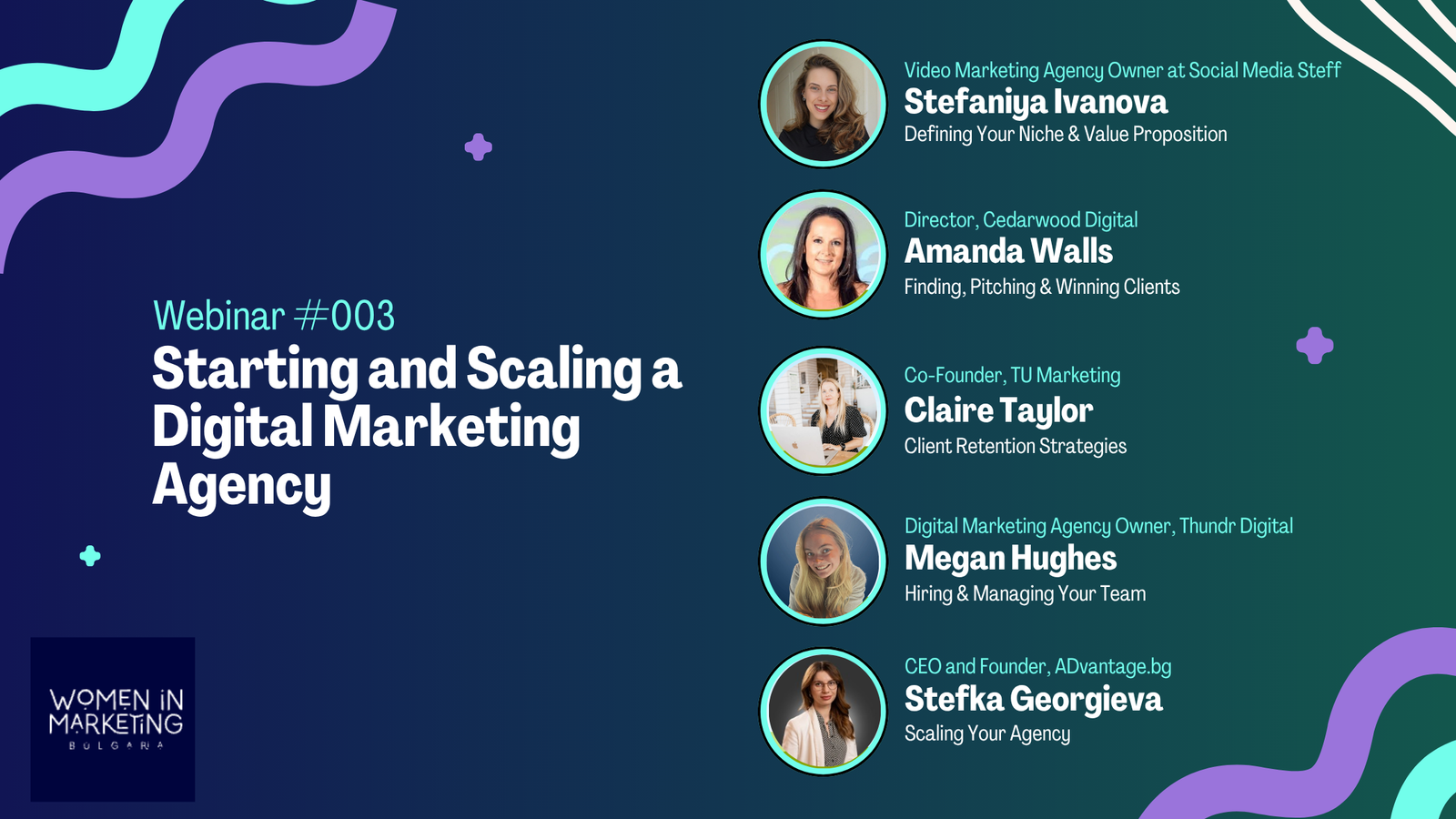
Starting a marketing business is one thing; building an agency that scales is another entirely. For our third community webinar we brought together five agency founders — from Bulgaria to the UK — to walk through the full journey: defining your niche, winning clients, keeping them for years, hiring and managing a team, and scaling without breaking what you’ve built.
Hosted by our founder Lazarina Stoy, this recap gathers the practical playbook they shared. Watch the full recording below, jump to any section, and don’t miss the bonus Q&A at the end. You can also revisit the webinar event page.
Meet the panel
Defining your niche & value proposition
Stefaniya Ivanova opened by dismantling a common myth: your niche isn’t just an industry. You can niche by industry, client size (startups, scale-ups, enterprise), business model (B2B, B2C), or service — but the most powerful niche comes from the problem you solve and your unique way of solving it, which competitors can’t easily copy. Start with your “superpower”: what you love doing and could repeat without burning out, what feels easy to you but is hard for others, and the results clients rave about.
Then listen to the market — observe the gaps and challenges clients keep raising, and simply ask them. Because people don’t buy your services; they buy the promise of a result. Distil it into one sentence: we help [ideal client] achieve [desired outcome] through [our unique approach]. And treat your niche as a living hypothesis you test and refine — it’s how Stefaniya’s own business grew from a TikTok/video agency into a full content partner.
People don’t want to buy our services — they want to buy the promise of a result.
Stefaniya Ivanova
Your actionable next steps
- Define your superpower: what you love, what’s easy for you but hard for others, and what clients rave about.
- Build your niche around the problem you solve and your unique approach — not just an industry.
- Write your one-line value proposition: “We help [X] achieve [Y] through [Z].”
- Treat your niche as agile — test it and refine it with client feedback.
Finding, pitching & winning clients
Amanda Walls shared Cedarwood Digital’s sales playbook, starting with a strategic choice: inbound or outbound. Around 80% of their inquiries are inbound — warmer, more engaged leads. To win them, make yourself known: a strong website backed by case studies (they have 60+ across their disciplines) and knowledge-sharing in industry publications. Then know your prospects — build buyer personas and always ask who has sign-off before investing in a pitch.
Don’t target everyone; build a niche list. When you pitch, lead with the client’s problem rather than yourself (a common agency mistake), bring an active solution with real examples, and tie it to the ROI they care about. Qualify hard — turning the wrong client down is fine — and always get a contract, with break clauses and a minimum term.
Agencies spend a lot of time talking about themselves, and not enough about the client’s problem.
Amanda Walls
Your actionable next steps
- Decide your inbound/outbound focus and build the assets for it (website, case studies).
- Qualify every lead: who has sign-off, and are they the right fit?
- Lead pitches with the client’s problem and a concrete solution + expected ROI.
- Always contract — offer break clauses and a minimum term.
Client retention strategies
Claire Taylor made the case that we over-invest in winning clients and under-invest in keeping them — yet her agency averages around eight years of client retention. Her playbook: own the relationship (don’t wait for the client — stay in regular contact, and don’t save everything for the quarterly review); under-promise and over-deliver, including in how you communicate and how enjoyable you are to work with; and structure contracts as a three-month minimum, then rolling.
Offer more value the moment it’s relevant — for example, managing a third-party agency for a small fee keeps you in the middle and adds value, and a little free AI-tool training goes a long way. Watch for churn signals (a client going quiet), call them, and nip issues in the bud. And price for the lifetime: with long retention your costs per client are lower, so you don’t have to raise rates as aggressively.
Own the relationship. Don’t wait for your client to come to you.
Claire Taylor
Your actionable next steps
- Set a cadence of proactive check-ins — don’t wait for the review.
- Find one relevant way to add value to each client this quarter.
- Watch for churn signals and address them immediately.
- Price for lifetime value, not just the next 12 months.
Hiring & managing your team
Megan Hughes went from wearing every hat to a team of 10 and growing. Her advice: decide when to hire with a clear trigger — a financial one (e.g. at a set monthly recurring revenue) or a capacity one (e.g. every six clients needs an account manager) — and hire before burnout forces the decision. On where: she blends overseas remote talent (half her team is South African — strong English, a 1–2 hour time difference, and lower initial costs) with a local UK hybrid team for the account management and social work that needs in-person connection and local knowledge.
Hire for fit, not just skill — she’s a “people person” and a call beats a CV. The tools that run her team: Deel for remote payroll, Slack for daily communication, and ClickUp for task management. And keep people happy — birthdays off, parties, team dinners, and ongoing training.
You can hire the most skillful person, but if they don’t fit the team, it won’t work. Culture matters as much as skill.
Megan Hughes
Your actionable next steps
- Set your hiring trigger — financial (MRR) or capacity (clients per manager).
- Consider a remote/overseas + local hybrid mix for cost and coverage.
- Hire for culture fit, not just skills.
- Put the basics in place — payroll, comms and task tools — plus a plan to keep people happy.
Scaling your agency
Stefka Georgieva closed with the systems side of growth. Before you scale, be a stable company — invest freely but mindfully in marketing, team, tools, and client relationships. Then build your business structure: as you shift from doing the work to running the company, add middle management and give everyone clear roles, responsibilities and expectations.
Only then scale — via three levers: grow your number of clients, add or upsell new services (video, SEO), or expand into new markets (for Bulgarian agencies, often Greece, Romania, or English-speaking markets). Her hard-won warning: don’t combine all three at once — she tried three times and it exhausted the team. Be patient, do one at a time, and lock down your quality and processes first, or you’ll fall into the “find a client, lose a client” loop.
Don’t try all three ways of scaling at the same time — I did it three times and failed. Your team will just be exhausted.
Stefka Georgieva
Your actionable next steps
- Stabilise first — invest mindfully and get profitable before scaling.
- Build structure — middle management and clear roles — before you grow.
- Pick one scaling lever at a time: more clients, new services, or new markets.
- Lock down processes and quality standards before you scale.
Bonus Q&A from the panel
After the webinar, some of our guests answered extra questions from the community. Here they are, in their own words.
Does it make sense to have pricing publicly on your website?
I used to list transparent prices on my website and social channels, but I’ve realized it no longer serves my business. Every client has unique needs, and even when two projects look similar on paper, they can require very different amounts of time and energy from my team. That’s why I now follow a more tailored process: 1. Client inquiry, 2. Introductory “get-to-know” meeting, 3. Personalized proposal. This way, each offer reflects the true scope and effort required.
— Stefaniya Ivanova
It’s one of those ‘it depends’ situations I think. Having prices visible can help to qualify leads in or out, but it can be difficult for marketing services to have set pricing. In this instance having a starting price or ranges can be equally helpful.
— Claire Taylor
What advice would you give your younger self?
I’d probably give my younger self different advice at different stages of life.
To my 14-year-old self: You are not weird – you’re wonderfully unique. People try to minimize you because they’re intimidated by how freely you speak your mind. Keep showing the real you.
To my 18-year-old self: You won’t fall behind just because you dropped out of university. Trust that inner voice – you don’t need to spend four years on information that doesn’t serve you. Your heart already knows the path and will lead you exactly where you’re meant to be.
To my 22-year-old self: Even if you don’t yet believe it, you are an expert in your field. You’re an amazing, inspiring, brave young woman with more talent than you realize. Be confident. Set clear boundaries. Put a higher value on your work. And stop stressing – you always find a way. Remember: even your minimum is most people’s maximum.
— Stefaniya Ivanova
Definitely not to care what other people think of me and to speak up more.
— Claire Taylor
When does an agency model make more sense than freelancing?
For me, the agency model made more sense than freelancing once I realized how strong the demand was for the service I offered. Framing it as an agency package helped me set clear time and scope boundaries – something that often gets blurry as a freelancer, where you can easily be mistaken for an on-demand remote worker who does everything.
— Stefaniya Ivanova
If you have regular retained clients and you are either struggling with capacity or some of their needs fit outside of your skillset.
— Claire Taylor
Common mistakes — and how to avoid them
Saying yes to everything – be really strategic about the work that you do.
— Claire Taylor
Lessons learned the hard way
Growing too quickly without strong processes in place. We did this about 5 years into the business and performance ended up suffering, as a result we lost clients. Systemising the business was an absolute game changer.
— Claire Taylor
Learn more & join us
- Explore the panel’s agencies: Stefka Georgieva (ADvantage.bg), Stefaniya Ivanova (Social Media Steff), Amanda Walls (Cedarwood Digital), Claire Taylor (TU Marketing), and Megan Hughes (Thundr Digital).
- New to freelancing? Read our freelancing webinar recap.
- Discover more community speakers and upcoming events.
Want more sessions like this? Join the Women in Marketing – Bulgaria community on Slack and subscribe to our newsletter so you never miss a webinar.
 English (UK)
  Български