
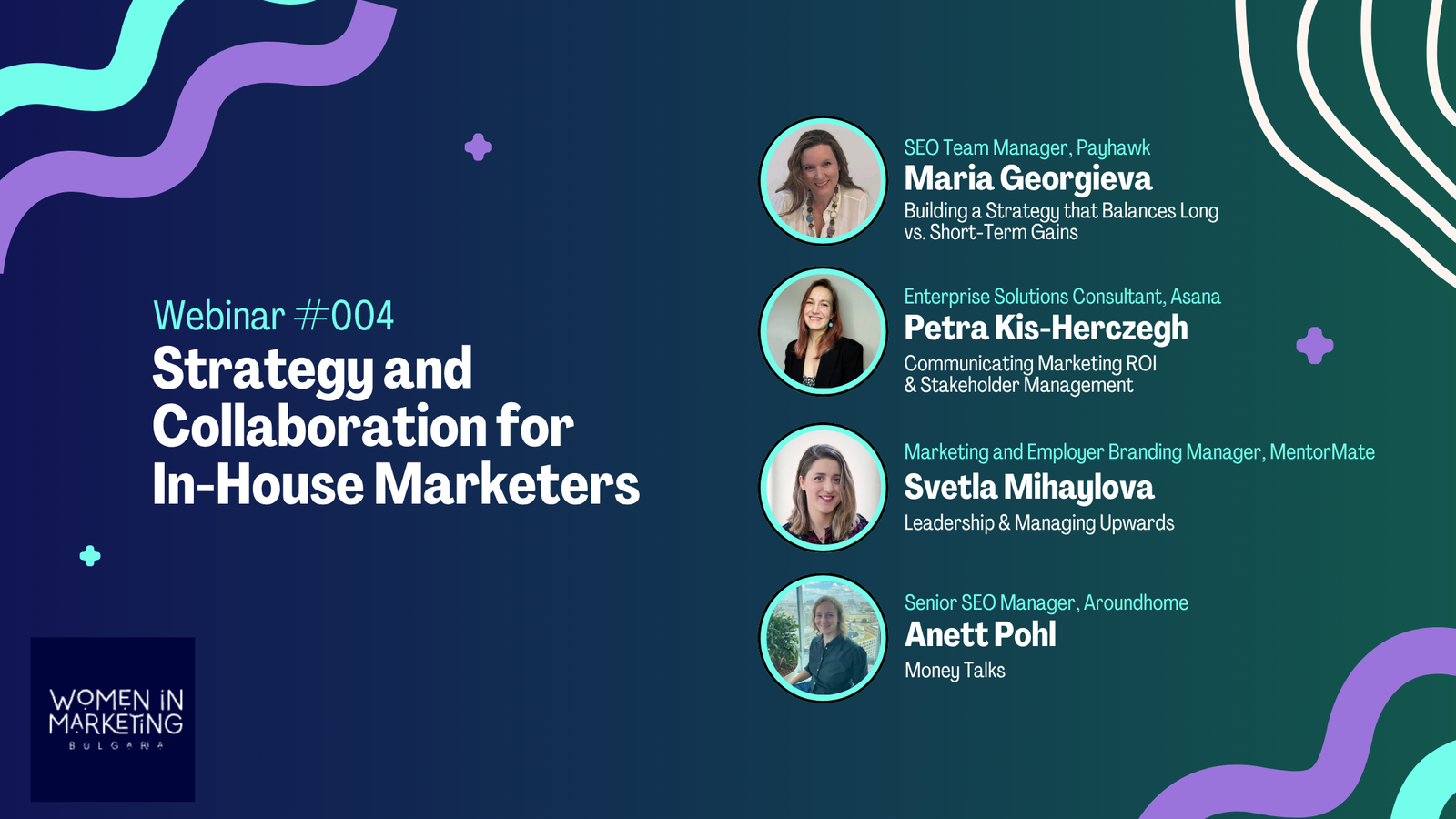
In this recap: how to build a strategy that balances long- vs. short-term gains, communicate marketing ROI to leadership, master cross-departmental collaboration and stakeholder management, and negotiate your salary as an in-house marketer.
In-house marketing is its own discipline. You’re not just running campaigns — you’re building strategy, proving ROI to leadership, navigating a maze of other departments, and steering your own career from inside the business. For our fourth community webinar, four in-house experts opened up their playbooks: what actually works, the mistakes they learned from, and the specific tactics you can put to work on Monday morning.
Hosted by our founder Lazarina Stoy, this recap gathers it all in one place. Watch the full recording below, jump to any section, and take the actionable next steps with you. You can also revisit the webinar event page.
Meet the panel
Table of contents
- Building a strategy that balances long- vs. short-term gains — Maria Georgieva
- Communicating marketing ROI — Petra Kis-Herczegh
- Cross-departmental collaboration & stakeholder management — the panel & Svetla Mihaylova
- Negotiating your salary & asking for a raise — Anett Pohl
- Bonus Q&A: storytelling when a campaign flops
Building a strategy that balances long- vs. short-term gains
Maria Georgieva, who leads the SEO team at Payhawk, opened with a stat that landed hard: according to Gartner, 84% of CMOs report high levels of strategic dysfunction in their teams. Her point was that in a world where customer behaviour is shifting constantly — and where every marketer feels the pull of FOMO, always chasing the newest tactic — the way you stay effective is to deliberately balance three different types of work, rather than lurching between them.
Short-term projects are how you prove your team can deliver — even if “your team” is just you. These are the things you can ship in a week or two (Maria counts up to a month for SEO, since results take time): on-page optimisation, a quick piece of content, a small experiment. Her advice is to run them as agile sprints and to test on a small scale before committing — you don’t need to test something on 5,000 pages to learn whether it works. And she governs all of it with a simple rule: “if something doesn’t exist in Jira, it doesn’t exist at all.” Planning every week keeps the team flexible enough to adapt as priorities move.
Long-term projects are the opposite — they stretch across quarters or a full year, and they’re what build your brand’s authority. The discipline here is patience plus communication: you have to over-communicate, up front, that these won’t produce results in the short term. Maria’s tactic is to borrow the framing leadership already understands — if the business accepts that its own KPIs will be hit in 12 months, use exactly that language for your SEO projects. And to keep the team motivated along the way, she breaks every big initiative into smaller milestones that can be achieved in two weeks or a month, so there’s a steady sense of progress.
Then there’s the layer everyone underestimates: business as usual. These are the constant, unglamorous, recurring tasks that are easy to forget — and they’re the foundation. If your website isn’t working properly, neither your short-term wins nor your long-term strategy will land. One exercise Maria’s team did at the start of the year was to track every recurring task so nothing slips through. Her warning: be disciplined, because these tasks don’t disappear — neglect them and they resurface, worse. Document everything, learn from your mistakes, and get creative when something isn’t working.
Crucially, the mix is not static. Reassess it monthly or quarterly as business priorities change, borrow tactics from project management for your day-to-day, and always align with leadership on the KPIs. Above all, remember what strategy really is.
Strategy is deciding what not to do — so be smart, decide what not to do, and don’t over-promise.
Maria Georgieva
Your actionable next steps
- Sort your work into three buckets — short-term, long-term, and business-as-usual — and deliberately balance all three.
- Run short-term work as agile sprints and test on a small scale before you roll anything out widely.
- Over-communicate long-term timelines using the same 12-month KPI framing leadership already uses, and break big projects into two-week milestones.
- Protect your business-as-usual tasks with discipline and documentation — and reassess the whole mix monthly or quarterly.
Communicating marketing ROI
Petra Kis-Herczegh reframed a task most marketers dread — proving ROI — as the single thing that turns you from an executor into a strategic partner. Why care about it at all? Not simply because the business does. Petra gave three reasons: it lets you justify your budget (so leadership stops seeing marketing as money disappearing into a black hole), it helps you prioritise (what to double down on, what to let go), and — most fundamentally — it creates strategic business alignment, which builds your own skills and makes your day-to-day far less stressful. Communicating ROI well means you start answering the two questions decision-makers really care about: “so what?” and “now what?”
The “so what” principle is the one we forget when we’re deep in campaign execution. Your decision-makers are silently asking, “So what? What does this actually mean for the bottom line?” So instead of reporting “we generated new leads,” go a level deeper and translate it into business impact. Petra’s trick is to literally ask yourself “so what?” of every number before you present it — and to present it in a way people can hold onto. She demonstrated with a huge, meaningless-looking data point (it could have been a product code) and made it unforgettable by reframing it through an analogy from Friends, breaking the number down into pieces people could relate to and remember. Because you can’t just present data — you have to tell a story. That’s the shift: from reporting to storytelling.
Her second analogy was a magic trick. Every great business transformation, she said, feels a bit like pulling a rabbit out of a hat — and the equation has two parts. The rabbit is the return (the amazing outcome) and the magic wand is the investment. When you watch a magician, you focus on the astonishing outcome, not the wand. So tell the story of the amazing outcome first, and your decision-makers will be the ones to ask, “What do I need to make that happen?” — at which point you name the investment.
Finally, none of this works without knowing your audience. Petra maps what stakeholders say against what they actually mean: IT might say one thing while really worrying it means more work for them; legal cares about compliance; developers ask you to log a ticket with clear specs, but what they’re really wondering is whether it’s worth prioritising. She also maps her blockers, her champions (the people who advocate for you when you’re not in the room), and her decision-makers — because the only way to communicate ROI is to first understand, and listen to, what each of them needs.
We have to go from reporting to storytelling — you can’t just present data, you have to tell a story.
Petra Kis-Herczegh
Your actionable next steps
- Run the “so what” test on every metric before you present it — translate it into business impact.
- Turn reports into stories and analogies people can relate to and remember.
- Sell the outcome (the rabbit) so leadership asks you for the investment (the wand).
- Map each stakeholder’s stated words vs. real concerns, and identify your blockers, champions, and decision-makers.
Cross-departmental collaboration & stakeholder management
Instead of a solo talk, the panel turned this topic into a round-table, each sharing their biggest cross-department challenge. Petra named listening — really listening to understand. Maria pointed to shared context and vocabulary: to her, “title” means the meta or page title, but a content manager hears something completely different, so a shared wiki or glossary prevents endless confusion. Anett made the case for reciprocal relationships built on regular check-ins — if you only ever appear when you need something, you become “the person that needs stuff done”; but if you understand what other teams need and offer help first, you build the kind of two-way relationship that pays you back. And Lazarina added a lens from agency life: when someone is stressing you out, ask who is stressing them — “if they’re blocking us, who’s blocking them?” — because seeing the person behind the problem builds real empathy and reveals where the misalignment actually is.
Then Svetla Mihaylova made it concrete with a story. Her team wanted to do something new at the biggest IT conference in Bulgaria (around 1,200 attendees a year): a giant puzzle-piece wall where people would each pick up a piece — with something they were missing in their career on the front — and, as hundreds of people took part, collectively uncover a hidden message. Designers, content writers, everyone loved it. Everyone except C-level and marketing management, who said it was too risky, too expensive, never been done. Svetla’s job was to win them over.
So she profiled the two managers who held the final approval and spoke each one’s language. The first was results-driven and a big visionary who spoke in numbers — so she talked in numbers, projecting 600 submissions (unheard of in the conference’s history), and she got the pitch in wherever she could, including a three-minute window in the elevator when she knew she had his attention. The second manager was completely different: he cared about the team and how they felt, was strongly analytical from a marketing (not purely financial) angle, and loved clear deadlines and tidy sheets — so she talked about how the team wanted to work on something creative, and put everything into monday.com so he could see it laid out.
Out of that came her framework: identify each stakeholder’s type (in marketing, most CMOs, VPs, and even CFOs and salespeople are results-driven, sometimes results-plus-vision); decide how you’ll communicate with them — numbers, story, or both (Svetla does both); work out which of verbal, visual, or written matters most to them; and then over-communicate. She keeps a set of email templates in her Drive for exactly this. Her closing point tied the whole session together.
It’s not just the message — it’s how you present it, and in what format.
Svetla Mihaylova
Your actionable next steps
- Build a shared glossary so teams mean the same thing by the same words.
- Set up regular check-ins and offer help first, to build reciprocal relationships.
- When someone blocks you, ask who’s pressuring them — lead with empathy to find the real misalignment.
- Profile each stakeholder’s type, tailor your message and format to them, and over-communicate.
Negotiating your salary & asking for a raise
Anett Pohl closed with a genuine masterclass on getting paid what you’re worth. On timing: the classic advice is to ask at a performance review or after a major success — but even if none of those apply, or your company is going through a hard time, you can always raise it, just to stay top of mind. What actually matters most, she learned, is asking in line with your company’s salary-review period: find out when your manager needs to submit the request, and when they in turn need to pass it up the chain (at her company, that’s late January / early February). Also learn how much time should pass between raises. Inflation is real and eating into everyone’s pay, so don’t be shy — managers expect you to ask.
On what to ask for: benchmark relentlessly. Use communities like Women in Marketing and Women in Tech SEO, sites like Glassdoor and Kununu, and — cleverly — ask peers “do you make more or less than X?”, asking a few different people to triangulate a realistic number. Dig for your company’s internal salary rules (most have them, few are open about them). Then be specific: decide what you’d like, then add a bit more. Don’t forget bonuses and benefits, which vary a lot by country. And use precise numbers, because they signal preparation and shrink the negotiation step: if you say a round “50,000”, the counter might drop to 45,000; but ask for “56,500” and the next step down is only 55,000. Adding a small, specific amount keeps you from being negotiated too far down.
A few hard rules. Never bluff — don’t threaten to leave for a competing offer unless you’re genuinely prepared to take it. And if a raise is simply off the table, negotiate for something else: a one-time bonus, conference tickets (Anett once got two conference tickets when a raise wasn’t possible — and got the raise a few months later), training, mentoring, more responsibility, or country-specific benefits like a commuting allowance. Just don’t take on more responsibility on the vague promise of “maybe there’ll be a raise.” Her three lessons learned the hard way: get agreements in writing (even C-level people leave — it once took her a year to get a promised raise), and don’t feel guilty about being well paid.
In every job you need to be learning or earning. If you’re not doing either, you’ve got to quit.
Gary Tan, shared by Anett Pohl
Or, as Lazarina put it in her memorable send-off: negotiate your salary with the confidence of a mediocre white man — or a five-year-old in a Batman suit.
Your actionable next steps
- Find out your company’s salary-review cycle and time your ask to it.
- Benchmark with communities, Glassdoor/Kununu, and peer “more or less than X?” conversations.
- Ask with a specific number (not a round one), and include bonuses and benefits.
- If a raise isn’t possible, negotiate training, responsibility, or perks — and get every agreement in writing.
Bonus Q&A: storytelling when a campaign flops
An audience question closed things out: what about storytelling and ROI when a campaign was unsuccessful — you tested a few channels and banners and got barely any leads?
Petra‘s answer: if you just present bad numbers, bad numbers are all people take away. But if you put them in context — why did this happen, what did we learn, how do we move forward — storytelling absolutely still applies; frame it against your short-term tests and long-term goals.
Maria added that you may need to step back and revisit the KPIs themselves: something like ABM won’t show results immediately, so if you measured it on the wrong timeframe, the KPIs — not the campaign — are what need to change.
Learn more & join us
- Connect with the panel: Svetla Mihaylova (MentorMate), Maria Georgieva (Payhawk), Petra Kis-Herczegh (Asana), and Anett Pohl (Aroundhome).
- More recaps: freelancing and agency growth.
- Discover more community speakers and upcoming events.
Want more sessions like this? Join the Women in Marketing – Bulgaria community on Slack and subscribe to our newsletter so you never miss a webinar.
 English (UK)
  Български