
Относно лекторите

Запознайте се с оратора
Лариса Иванова
Лариса Иванова има над 8 години опит във видео оптимизацията и стратегията, подкрепен от степен по психология и солиден опит в маркетинга. Тя е основател на консултантска компания, посветена на подпомагането на малкия и среден бизнес да се развива чрез YouTube. С допълнителен опит в управлението и организацията на събития, Лариса предлага уникална перспектива, която съчетава поведенческата наука с дигиталната стратегия, което прави Video SEO нейната истинска суперсила.

Запознайте се с оратора
Василена (Васи) Вълчанова
Василена (Васи) Вълчанова is an expert in content marketing, brand positioning and copywriting. She has over 15 years of experience in building comprehensive marketing strategies, content planning and creating texts that reveal the value of the brand. With her skills, she has helped SaaS platforms with over 500,000 registered users and e-shops with €12,000,000 annual turnover. She also works with agencies and experts offering B2B services who need to strengthen their role as opinion leaders in their field.
Запознайте се с оратора
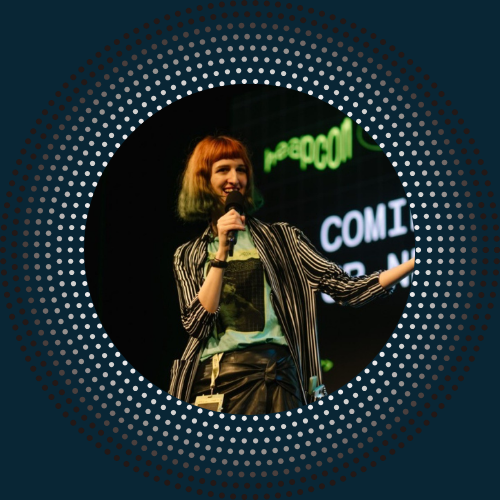
Ива Йованович
Ива Йованович е опитен специалист по маркетинг на съдържание, SEO консултант и организатор на Белградската SEO конференция и Heapcon. Тя е специализирана в SEO и създаване на съдържание за уебсайтове и социални медии, но работи и с техническо SEO и уеб разработка.
Нейният опит в трансформацията на съдържание идва от годините ѝ в превръщането на неефективно, остаряло или фрагментирано съдържание във високоефективни ресурси, като същевременно създава свежо и високоефективно съдържание. Тя разработва стратегии за съдържание, фокусирани върху намерението за търсене и потребителското изживяване, превръщайки идеите в страници, които се класират и конвертират. Работейки на платформи като WordPress, Webflow, Wix и Duda, тя оптимизира елементите на страницата, преструктурира йерархиите на сайта и пренасочва остарели или неефективни ресурси в нови публикации в блогове, целеви страници, ръководства и социално съдържание, които водят до постоянен трафик и ангажираност.

Запознайте се с оратора
Лазарина Стоянова
Лазарина Стой е маркетингов консултант, обучител и лектор, специализирана в SEO, машинно обучение и наука за данни. Работила е с безброй B2B, SaaS и големи технологични екипи, за да подобри тяхното органично позициониране. Лазарина е и основател на MLforSEO – платформа за машинно обучение за маркетолози, работещи с органично търсене, и основател на общността „Жените в маркетинга – България“.
Препис на панелна дискусия
Лазарина Стой: [00:00:00] I have my questions on the phone this time because I’m a very professional woman. Please introduce yourselves again in terms of this panel. I’ll actually take a seat because I love the spotlight. I’m sorry.
Iva Jovanovic: You deserve to sit a bit
Лазарина Стой: I, yes, I do. I really wanted to be a part of this. Panel and because I’m organizing the event, there was nobody to say, no, sorry I did it.
Sue me. Yeah. Why I wanted to be a part of this panel and why we have this panel. Larissa, you would probably look at her presentation and you would say, why is she not a part of the video SEO o panel? But I think a great transition to what we just spoke about is that especially for companies, but also for personal brands, we are in this era of AI specifically, and.
Different growth of different social media platforms and content marketing workflows in general, where you might have a blog post, you might have a newsletter that you have been running [00:01:00] for, let’s say a decade. If you are a brand specifically, you have a ton of content. You have been investing in however many initiatives, and now is the time where if you haven’t been doing it so far.
Everyone is saying, build a brand on every platform. Transform your content. If you can do it yesterday, that’s great, but if you can’t, then use AI to scale it. Do it. And I think it’s, it’s so important to. Have your expertise and I will stop talking in a moment, I promise, but just to, to have the different perspective, especially for both personal businesses and for brands, how to actually transform content for different platforms and how to make it scalable, authentic, and not ruin the brand image in the process.
Because most of us are working for companies, but we also might be interested in scaling your own company, building a business, selling a product, building your personal brand. So I think it’s important to have the discussion from different. So please,
Iva Jovanovic: thank you. I’m Iva Jovanovic. I come from Serbia, so I do understand [00:02:00] Cirillic.
So Dobri Den to everybody. I am a freelance, SEO specialist and content specialist all around digital marketing specialist. I do social content, SEO, and I also organize events. I know what Laina is going through. Literally I organize conferences and yeah, that’s basically it.
Vassilena Valchanova: Hi again, everyone. Nice seeing you here.
Yeah. Jokes Society. You already know what I do. Content marketing, messaging, everything related to words is essentially my jam. And I am very excited to be on this panel because there’s a Type A personality and someone who promises companies that I’m gonna take all the random acts of marketing that they’re doing and structure them and give them like a baseline to actually smooth out the process.
This is. Weirdly enough, the most exciting part of my work.
Larisa Ivanova: Hi again. I don’t know what to say more to after the presentation, [00:03:00] but it’s really interesting to see how content transformation works, uh, through the psychology of the audience and basically. Every single type of content could be transformed, created, used in different ways.
You just have to have the right angle, the right approach, and the right plan in your head just to execute it perfectly. Sounds so
Лазарина Стой: easy, right? Yeah. Just do
Larisa Ivanova: it.
Лазарина Стой: Yeah. It’s so easy. Absolutely. Okay, so first question, workflow design, uh, AI assisted. Where do you add AI in designing a workflow specifically for transforming content?
Where would you advise against it?
Larisa Ivanova: Starting from me. Okay. I would basically use AI for, because I really love to create my scripts alone. I would love to type my scripts my own because I want to share my own experience [00:04:00] with the audience, and afterwards, whenever everything’s ready, I will put through a model just to see how it can get better.
Most of the time it has some gems. And it’s, most of the time doesn’t, of course, one of the places I would absolutely advise not to use AI is researching because I have been unfortunate enough to just for the test, just for the trying out, I tested, I tried to research different channels in specific topic, and fortunately few of the people on the list.
Weren’t available on the earth at the moment. Yeah. And yeah, it’s so surreal. So when you’re researching, use your analytics thinking brain and just be well curious.
Vassilena Valchanova: Cool. I think that’s a great point and my main goal whenever I’m on a panel is [00:05:00] to pick a fight with someone. So I definitely hardly disagree on using AI to research, but you do need to fact check like a lot like you first off, like when you’re getting the AI to do the research for you, you can use some specific phrasing and tricks to actually get it to hallucinate less.
Not hallucinate because that’s still not where we are at. But yeah, in any case, like getting it to include source links that you can easily check afterwards, that’s like a way to, to get the best of both worlds. And going back to the original question, I think I really need the human element at the start and at the end of the process.
And I try to pick points in the middle where I can automate and I can use AI to fast track it. When I say the start and the end, meaning like. Ideation. You are doing that. Like no AI is gonna have a better, more original idea than your own. Might not be a good idea, but it’s gonna be original. Right? Then [00:06:00] you can use AI to strengthen it the back and forth way that I was talking about in my talk, and then at the end, like you definitely, I’ve never published something without having it go through human quality assurance because it’s just.
Uh, there there’s gonna be this uncanny valley effect that Lara was talking about. There’s gonna be weirdness that just doesn’t sound like the brand, no matter how good a brand guide you give it. So you definitely need a human in there. In the middle parts, there are a lot of points where you can automate, provided that you know your process.
But this is something that we’re gonna talk about later.
Iva Jovanovic: I kinda agree with everything that you said about see, basically, yeah. I’m a very big advocate of creating a process of things that you do and then seeing where you can put in the AI to help you out. Definitely never with the start, you have to make your own plan.
If you’re talking about social, you need to create, what kind of posts do you wanna do? If we’re talking about blogs, you need to know what topic you’re [00:07:00] doing. On email as well. So you have to start with what you’re doing and you have to know what you’re doing so that the A, so that you can give it to the AI and the AI can know what you’re doing on the research.
Definitely both points are valid. I use it to research so it hallucinates a lot, but there are ways around it. Sourcing is one, and also I have been testing out the, it was previously included in the regulatory GPT. Now it’s separate. Dunno why the deep research part, it gives out good things. I’ve even used it to like.
To automate the, like when you, I work with a lot of SaaS clients and they do want to have the industry trends and news and things posted, and I’ve used deep research to help out with that. It was beautiful. It cut down my work by a lot of hours. So my approach to adding AI to the workflow is seeing where it can help me out, whereas not to replace myself with it or like completely dive into [00:08:00] it and just give it work for me.
No, I really wanna. See where it can help me save time so I can go travel like this. And while I was working agency side, we also experimented with the AI to see where it can help out. We definitely never replaced any humans with the ai. We just helped the humans do more work in one day than than they were previously doing, especially in terms of content production.
Лазарина Стой: Awesome. So who was here last year for my presentation? Do you know what I’m going to say? We are using AI wrong in this panel. No, I’m kidding, but so I, maybe I’m wrong, but when you use the word ai, you’re referring to no code chatbots, right? So yes, LLMs, yes. What I would say is, that’s why I wanted to put myself in the seat.
There is a ton of ways to add machine learning models, which is a subset of ai, not as popular, not as trendy right now, but. [00:09:00] Add machine learning models to the steps where you can control parts of the process, right? Because some of the problems with hallucination can be resolved as a result of that. And one top of mind example is, let’s say for instance, you’re trying to do a competitor research audit for YouTube.
And because you want to see what your competitors are doing, you can export the videos. You can transcribe them using APIs. You can do an entity analysis. You can see what the core topics are. You can do topic modeling. All of these scripts, different tools are out there. You can do a content gap analysis where you can fit in.
All of these are extremely easy. This is one thing that I want to say, and also whenever you are trying to find a way to transform content, I think knowing exactly what is acceptable to be automated and to add value [00:10:00] immensely. So let me start with an example. I used to work with AWS who had a massive library of written content, and we were thinking of whenever AI wasn’t really in the boom and the models weren’t as good, but they had internal models that they could use for different types of transformations.
So we wanted to think of ways. How can we add value through the use of automation? So let’s say for instance, you have a tutorial and you’re trying to make this content format richer. What would be a great way to do that? You already have still screenshots. Perhaps it could be an audio walkthrough for people so they don’t have to do the same process.
Going back to the blog. Looking at the screen, they could just hear it, right? So this is a great example of how you can add a simple automation for that. Now, let’s take it a step further. If we were having the same conversation today, why would it be a problem to have a synthetic persona that based on someone that works from AWS to do that?
Because people don’t really [00:11:00] expect that. Super, super personal. Someone stood in a studio for months and months at a time to record the entire library of AWS. Of course, you’re one of the big tech giants. Just use automation for this, right? So just make a decision on what actually works for your brand.
Make a decision on what works for the particular content format. Split it in a way. You have control over different parts of the process and choose the appropriate tool for the task. Of course, LLMs are great. I’m just here to say they’re not the only part of ai, and explore other machine learning algorithms that can help with different parts of the task because that’s where the real value is when it comes to scaling a system, in my opinion.
Larissa, which content format do you think people should start from? That is the best whenever they’re, let’s say if someone was building a content strategy from the beginning with a brand or a business or something that is just now starting, what would you [00:12:00] recommend is the content format that they start with?
Would it be blogs, newsletters, video shorts, case?
Larisa Ivanova: Case studies. Basically, you have everything in the case study and afterwards, videos, blog posts, social media, everything from a case study. But I think the case study is the priceless piece of content out there. Let’s hear your thoughts. No,
Vassilena Valchanova: definitely not.
Provided that you do have the case studies, I think that’s a great point because back in the day when I was doing CRO, the golden rule was you start conversion rate optimization from the point closest to the money, so. With case studies, it’s the same idea. Like you, you start from a format that’s already, if a person looks at it, then they have a good level of buying intent.
Like they’re either middle of the funnel or already at the bottom of the funnel and comparing options. So that’s a great point. I wouldn’t have thought about that. So close to, that’s an original [00:13:00] answer in my opinion. I think like from my point of view, I’d say long form content in whatever format works for you.
For me, that’s written content because I. Hate being on scripted video. Doing a talk is amazing, but like having to go through 28 takes for a half minute, like video invite that’s like literally like Dante’s ninth Circle Hell for me. So really looking forward to your course, by the way, so you guys are gonna have to help me out.
Great.
Лазарина Стой: We’re in the ninth circle right now.
Vassilena Valchanova: So if you’re into written content like I am, then starting with long form, like blog posts or even a newsletter can be a good place. So what I’m doing with my personal content now is in my newsletter, I have a editorial piece, which is like 800 to 1000 words, essentially. And then I repurpose that for social media posts, and it works like a charm, if you prefer [00:14:00] video, than doing long form video the same way that Lazarina was talking about earlier, with a very clear idea of where you are going to take bits and repurpose them for short form. This is like any one of these can work provided that you start with something that gives you enough heft, enough volume to then feed into the rest of your social media funnel or content funnel in general.
Iva Jovanovic: Not picking a fight,
but
Vassilena Valchanova: I’m glad I started the trend.
Iva Jovanovic: The clients I worked with never ever had a case study until two years later. So starting with a case study was nearly never, I don’t think. Yeah. I may have had one client in my entire life that had maybe a case study, but not many have actually that kinda material. It is a mistake not to have it, but then again, you have to build out all the other things.
I get it. From the business perspective, my go-to, and this is coming more of on a SEO side perspective, is [00:15:00] get your website in order in terms of copy. So the first thing. I would start and forever ever do tell my clients, fix your damn homepage. So don’t a, don’t just give your GPT and give me like a few things to pull on my homepage.
No, your homepage is your identity. That’s the link you post on your Instagram bio, on your LinkedIn about, that’s the link in the video descriptions of, of YouTube or whatever. It’s. Something that’s on the G on the Google business profile, that’s the first thing they go to as well. People wanna validate who, who you are and what exactly do you do.
So in my experience, the businesses I’ve worked with never ever had a clear messaging of what they do or what they offer or what their tooling is. I, all the businesses I worked through, we have gone through multiple iterations of fixing the homepage, adding the about page, adding the why, choose us, maybe those kinds of things.
Exactly. Exactly. Those are the. People need to [00:16:00] buy your things, buy your software, buy your products, or get your services. If it’s an agency, if it’s a SaaS, if it’s whatever, people still need to see what they do, what you, what the businesses does, what you do as a business, and see why you’re worth their time at all.
So my kind of like where you start and where you build out is the homepage. ’cause that’s also something that builds your brand. With building out your homepage copy. You get your brand voice, your brand tone, you get everything. And then you can use that to build out all the other things. And of course you can do, you can build out a lot of content simultaneously.
Like you don’t have to just do the homepage. You can just like work with the case studies or the blogs or social media, but you need to have your website in order, at least with the basic five pages.
Лазарина Стой: Absolutely, yes. Agree on case studies. Agree on starting with the richest, whatever works for you. Rich content format.
I always advise, start with long [00:17:00] form video. This is my advice currently and it will be, it has been for the past two years. I’ve tested it out. I know it works and with different brands and also myself and the businesses I run, so. Whenever you, my only 2 cents here are map out what you’re going to transform to.
Before you start creating, so if you are research, what is going to be the channel that yields the most for your business? That is different. I, it took me six years in marketing to discover email marketing, and it was actually through you and implementing this, for instance, for my academy business and also for the community.
I think this is. One of the best ways, if not the best ways to connect and use it as the last step before purchase case studies, of course. But email is literally the last step before, at least from what I’ve seen [00:18:00] and this I’ve discovered in my private practice. Just because in enterprise, you never talk with these teams, right?
That’s crazy. But whatever. What I’m trying to say is map out what your channels are. You don’t have to compete in all of them, and definitely don’t compete in all of them because you’re not going to do it. Choose a few and choose them, not based on, I woke up today and I chose to do TikTok. No, choose them based on where your audience is.
Because starting anything that you do has to be with audience first, where they are, which platforms they’re on, what kind of content they like, and then map out the content transformation starting from that. So if you see that within your strategy, you have more video. Content platforms then start with video.
Of course. What’s the point in doing blog posts? Of course you can transform video to blog posts, but it will be a much higher effort to do it the other way around. And typically what I’ve seen with organizations [00:19:00] is because blog posts are easier and email newsletters and. Case studies and so on. They will actually not get to the video part because they’re out of budget.
There’s no time for this. Oh, and now it’s Black Friday, and then it’s Christmas, and it is, oh my God, we haven’t done video for five years. Why are our competitors better on YouTube? Definitely map it out and actually have a process for. What you’re transforming where, and it will be a lot easier to start with scripting or whatever else it is because you are thinking from the very process of creation, you are thinking of distribution and how you’re going to reach those people on the different platforms and you’re creating with intention.
Which is what marketing should be about, in my opinion. Last question that from the ones that we have prepared, which I had a document with 30 odd questions, by the way, for each of the panels. That was cute.
Let’s be here until 2:00 AM Yeah, so last question is just, and I will sit this one out because I would love to hear from you guys. Girls, sorry.[00:20:00]
Ah, got me. The patriarchy got me. Sorry. I do want to hear, what are your kind of systems when it comes to prompt generation? Do you have specific processes of what prompts work for you? Whenever you’re transforming content from one form to another, how do you keep track of the processes that you have maybe for different clients?
For different industries and basically what is your process? If you want to talk in case studies, if you want to talk to talk just for a specific transformation, from one content to an another, what is your process for getting the content piece from one process to another, and where do you actually have your input?
We did discuss researching, but I just want to hear the process from start to end with a case study or whatever else has worked for you.
Iva Jovanovic: Awesome.
Vassilena Valchanova: Okay, since I also have a mic, I can use it. So, o one important thing, like I, I’ve [00:21:00] studied public relations in university and they always said like, when you get the microphone, no matter what the journalist tasks, you can always switch back to what you want to talk about.
So I’m gonna. So basically the thing I would, I would put as like stage zero in, in this whole discussion is, and I know that this is like an accountant speaking at like a Hollywood conference, like we’re talking about co-creative stuff. We’re talking about innovation and the future and technology, and I’m like, you need to do documentation.
But it’s true. I’m currently working with a team who are they? They already secured their series B. They’ve been around for years. They have a big established marketing team, and they don’t have one single process listed out in detail with a RACI metrics with step-by-step play with. Proper understanding of who does what, when, what needs to be The gate checks at [00:22:00] each step.
They have it in their mind. They’re great, they’re great people. They’re, they are doing it. They have a shared understanding that’s never been documented. And now we are trying to build, we are trying to build AI projects. And I come into this whole thing and I’m like.
Like how do we get about that? So the first thing we do obviously is I sit them all down in a nice, neat circle and I go, okay, tell me the whole thing. And we record this, and then I get my AI and I have a, I can also add this to the page I shared with you. I have just recently out of necessity for this particular project alone, created an AI process writing assistant.
So I just. Speaking to the mic, tell it the whole thing. It asks me questions where it doesn’t understand the process, where it needs clarifications, and then it builds documentation for me. And it’s amazing, even though I say so myself. So you need to start with having a clear understanding of [00:23:00] what’s happening in order for a long piece of content to become a bunch of short pieces of content.
And what’s the quality criteria that we need to clear and how does it move through the. Different team members who needs to say the go ahead and so on and so forth, having cleared that out, I think from then on out, it’s also have having this process laid out. You, you have a, an understanding of these are the places where we need, going back to my first answer, this is the places where we need people to put in ideas into the system.
And this is where we only create AI tools to strengthen these ideas rather than provide ideas on its own. And then these are the places where we can actually. Get this long piece. Ideally a long form video, I agree with you, is the strongest thing for two reasons. The first one is that it’s very rich as a content format.
It allows a lot of [00:24:00] repurposing because you can easily turn video into written content. The other way around is still not to the example you shared. It’s still not as good as we want it to be, but also in video we are. Much less self edited, and there’s a lot more personality built into video content, so it’s easier to get the voice right when you’re working from video.
Written content is usually a bit stiffer, a bit more edited out, and you edit out the personality oftentimes as you go along. So I would start with video. Figuring out what to cut and where to cut. I think it’s a good job for AI sometimes, especially if it’s a language that the AI understand well. In Bulgarian, it’s a bit more of a touch and go situation, and then ha having these individual pieces finalized, created captioned.
[00:25:00] Built into individual videos. Creating short introductions to each short video with our brand voice. Having that AI trained on our brand voice and our messaging and everything that we want to put in there, that’s easy to do. This repurposing when you have a rich starting content piece like that, and then you need the human.
Quality checker at the end who says, yeah, this is good enough to go out. We need to improve this here because it doesn’t really sound like us. It sounds like a robo version of my brand. And then you can push it out. That was a long-winded answer. Sorry about that. Yeah, I saw that. Sorry.
Larisa Ivanova: Perfect. Pause. Love it there.
Okay. Sorry.
Iva Jovanovic: Yeah, go. Okay. Even I think I remember the questions. Kidding, kidding. No. I am a very organized person. My bookmarks are organized, my Google drives are organized, and then I come into startups.
You [00:26:00] can imagine the nightmare I like the last startup I started working for was a year ago. And they have nothing. They still have nothing, no process, no work full, no anything, just all of us 24 7 running out and we pulling water on, pouring water on the fires. So I, whenever like I start working with a client that doesn’t have a workflow and it’s always, I tend to create that workflow, however.
I don’t use AI to create the workflow that I haven’t done, but in terms of like workflows, repurposing content, we, I’ve had success like converting a blog post to social media. Social media to blog posts as well with them. And what I do is I experiment, I try all the ai, so I have accounts on deep seek pt, the Gemini.
Claude Perplexity, all of them. And I experiment with them. I wanna see what, which works for what, how they work. And [00:27:00] I try different prompts until like I do spend a lot of time on doing that, but hey, there’s some fun in it, some. And I experiment what, which one of them can do what for me? And where can I improve the prompt?
And whenever I find something that works, I put it into my personal notes and then I repurpose it for another client. Then tweak it to see where that works for that client. ’cause different industry, different kind of thing, different messaging, different brand. So I’m always like finding new ones to do.
And we’ve had, like with most of the clients, it has really shortened my time on working on content. And we’ve also, for the meet, for the events I organized, we’ve also implemented DEA ’cause. Most of the events I organize are tech events, and I’m really talking Java software engineering. I have zero knowledge of what.
They’re talking about, and whenever we have a meetup or a conference, I’m supposed to nod and make notes what we’re gonna put later on as our [00:28:00] content. Hell no. So we’ve implemented like using AI to record and transcribe things and then using AI to give us, what the hell is this about? Can we use it for something especially ’cause like in the, I organize a conference and in my team we have two people who are actual developers.
So the rest of us, even though we have different roles for marketing, are. Marketers basically, and none of us can understand what is going on, and we have to go through the videos, make sure the titles are there, turn those videos in, social media posts, turn those videos maybe into something, blog posts, emails and stuff like that.
We can do this. So AI has been really helping us that, ’cause previously before LLMs came into play, we weren’t doing anything. We were just posting the videos and leaving them on our YouTube and being like, Hey, they’re talking about something smart. Go look at it. Whereas now we have added, the LLMs have helped us add a personal touch.
So now I can actually [00:29:00] understand, understand, I can get the gist of what they’re talking. LMS can help me create the social media or the blog that actually goes into what they’re actually talking about. Instead of me learning what framework is happening in JavaScript or what new whatever in Java is. I have no idea.
You can see how much I don’t know, but hey, we have success with it. So it’s basically, yep. I tend to use, I implement AI in my workflows as a way of shortening the time I spend on working on something and to help me understand things I don’t understand. ’cause I will never understand some of the things I work with, but that’s okay.
I have now help. Instead of going and crying to my boyfriend with a programmer, what the hell does this mean? Now I can go, Hey to GPT, what the hell does this mean? Basically. I am not replacing my boyfriend. This is being recorded. I’m not replacing him. I am just using my time smarter.[00:30:00]
Larisa Ivanova: Okay. Yeah. Shortly. Yeah, absolutely. We are very
Iva Jovanovic: sorry.
Larisa Ivanova: Oh, no worries. I have just two things to add to all this, because I really agreed with everything from a psychologist perspective. I would love, the first thing I would do when I start working with clients is to see what they’ve got, what they are good at, and what.
Type of AI support they could use because in different teams, different things could be polished with ai. And I would use the specific situation, specific brand and what they have and what is their strongest. Way to work, and I’ll use AI there and I’ll analyze what are their process at the moment, if they have any.
If they have any. Yeah. And if they don’t, I will try to find the best way to create a system for them that would work with the specific type of [00:31:00] people in the team because. Nothing ever works the same for two different teams. So yeah, this is mine. Thank you. Лазарина Стой: Okay. I’m very sorry. No questions. Life happens.
 Български
  English (UK)