
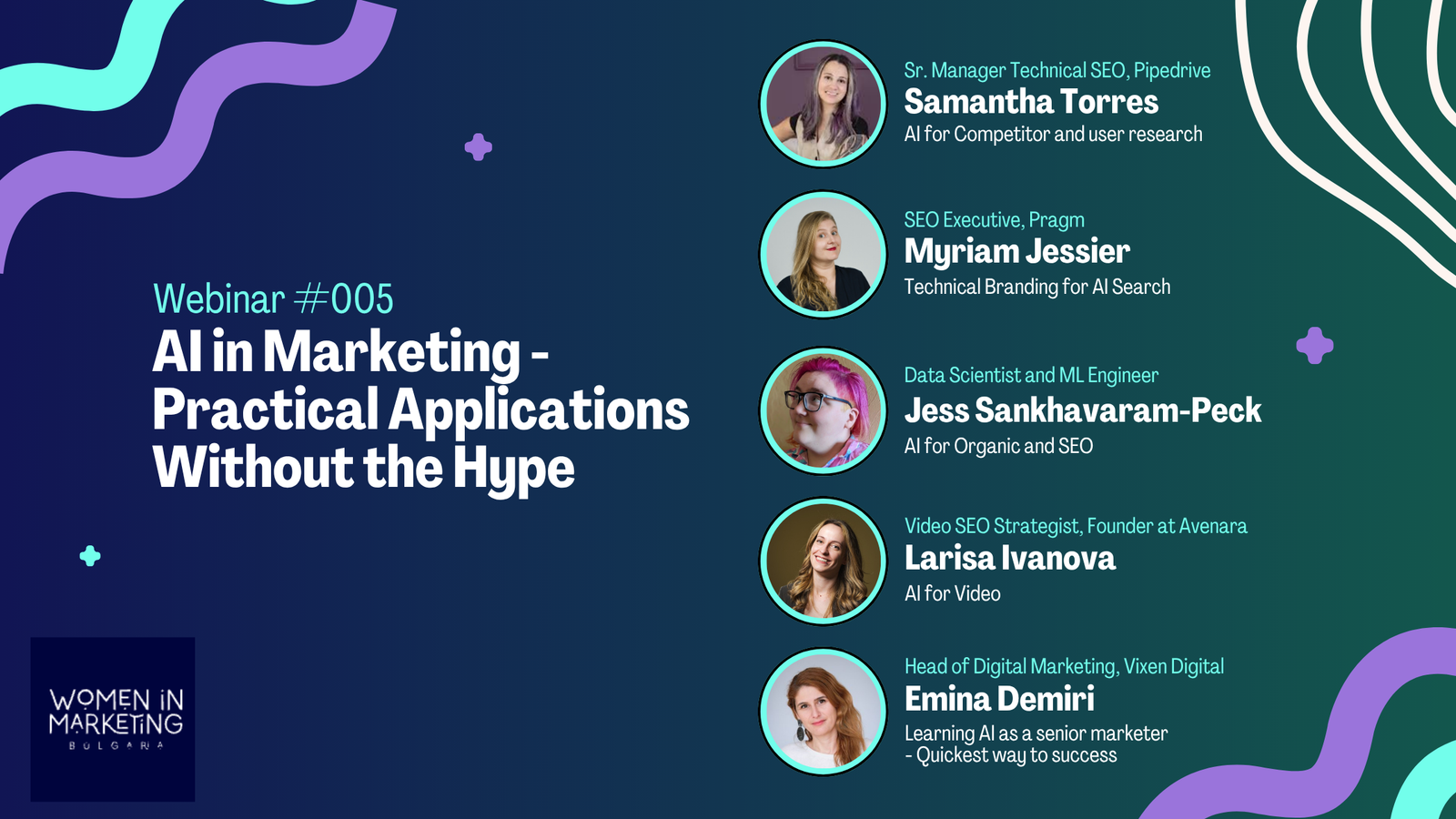
In this recap: learn to use AI for competitor and user research, technical branding for AI search, organic marketing and SEO, and video — plus actionable first steps for learning AI as a senior marketer.
AI is everywhere in marketing right now — and so is the hype. For our first webinar of 2026, we brought together five practitioners who actually use AI in their day-to-day to cut through the noise: where it genuinely helps, where it quietly fails, and how to stay firmly in control. No hype, just practical applications you can try this week.
Hosted by our founder Lazarina Stoy, this recap gathers their playbook. Watch the full recording below, jump to any section, and take the next steps with you. You can also revisit the webinar event page.
Meet the panel
Samantha Torres
Sr. Manager, Technical SEO, Pipedrive
Myriam Jessier
SEO Executive, Pragm
Jess Sankhavaram-Peck
Data Scientist & ML Engineer
Emina Demiri
Head of Digital Marketing, Vixen Digital
Table of contents
- AI for competitor & user research — Samantha Torres
- Technical branding for AI search — Myriam Jessier
- AI for organic & SEO, without losing control — Jess Sankhavaram-Peck
- AI for video — Larisa Ivanova
- Learning AI as a senior marketer — Emina Demiri
- Panel: the future of AI in marketing
AI for competitor & user research
Samantha Torres, who recently moved from agency to senior manager of technical SEO at Pipedrive, set the tone for the whole session with one principle: AI should be your research assistant, not your strategist. She’s watched clients and colleagues let AI make decisions for them — but it doesn’t understand the nuance of your market or who you are. What it’s brilliant at is processing a huge amount of data quickly and helping you find patterns you’d never have time to surface yourself.
Her framing for finding useful workflows: think about the datasets you wish you could analyse at scale — and if a source has an API, you’re usually in business. The YouTube API is beautifully documented and easy to build tools on; Google Business Profile reviews (yours or a competitor’s), competitor email newsletters (gold for SaaS), and product changelogs all reveal how a competitor is shifting. Sam shared a real example: for a prospective client she used the OpenTable API to find underserved cuisines and areas in a city. The troubleshooting, she noted, becomes a skill you build over time — the more you do it, the easier it gets.
A concrete workflow she demoed (with a fictional example): feed the model competitor email files and prompt it to draft a Google Colab notebook that extracts the subject lines and body text, then analyses which topics and features those emails talk about and how often — surfacing, say, a competitor that used to push one feature and has now pivoted to another. Because it’s a repeatable tool, you re-run it to stay current and get fewer surprises.
On user intent, Sam pushed past the traditional four buckets (navigational, transactional, informational, commercial). Go a layer deeper: what is the user actually frustrated about, and what prompted the search? Then bring in other signals — YouTube comments, Google Business reviews — and mesh them with your topic clusters. Using this process on one project, she uncovered three genuinely distinct audiences, which told her the site needed three distinct pieces of content.
Her cautions were just as practical. Hallucinations show up most on live fetches and crawls (the model will confidently report rich snippets that aren’t there), so she works with a bias toward feeding the data into the model herself. Models also mis-weigh metrics — one had judged a competitor “strong” on a topic purely because it had 40 pages on it versus three on another, when page count says nothing about authority; you have to qualify what actually matters. And on privacy and compliance: never feed personal or confidential data into an LLM. Sam uses Claude to build a Colab notebook so she can analyse her GSC and GA4 data locally, without any of it going into a model.
AI should be your research assistant, not a strategist.
Samantha Torres
Your actionable next steps
- List the datasets you’d love to analyse at scale — start with anything that has an API (YouTube, reviews, changelogs).
- Build repeatable Colab workflows (e.g. analysing competitor newsletters) so you re-run them and stay ahead.
- Go deeper on intent — what frustration prompted the search? — and mesh it with reviews and comments.
- Feed the model your data instead of relying on live fetches, qualify the metrics that matter, and never put personal or confidential data into an LLM.
Technical branding for AI search
Myriam Jessier opened with the perfect answer to the “GEO vs AEO vs LLMO” acronym debate: her preferred term is “whatever my clients call it.” The label doesn’t matter — what matters is what you do with it. And what she does is solve a very old problem in a new way. Technical SEO has always struggled for budget because it’s like selling insurance: nobody has fun buying it. So Myriam reframes the work as technical branding — treating your site infrastructure as a literal identity protocol that governs how your brand comes across when AI narrates it. Framed that way, people actually want to fund it.
The core risk she’s protecting against is AI brand drift — when your brand gets collapsed into a competitor’s, or when the model surfaces the wrong information about you. Think about what happens when someone asks an AI about your brand: it goes online, checks sources, verifies whether it’s confident, and scores the risk. The practice of technical branding includes bot governance (making sure a model doesn’t take a partial read — glance at a small window and leave), keeping every shareable asset accurate and readable, and making sure an old PDF claiming you cost $8 when your price is $12 never becomes a source. Hallucinations cost real money — she pointed to restaurants fed up with customers arriving on wrong information. And you reframe the value for each stakeholder: for a CMO, “I’ll make sure the brand stays consistent even when AI summarises it, even though we get a new answer every time.”
Her most concrete tip: we now have to optimise for the “machine gaze.” For video in particular, that gets technical — AI samples video at roughly one frame per second, so if you use rapid TikTok-style smash cuts, the model simply can’t follow it. Instead, you need to chunk your video and give it real structure (yes, pre-chunking), stay consistent across script and visuals, and use deliberate, dramatic pauses as a kind of “audio bolding” — using your cadence to signal what the key points are.
Reframe your site infrastructure as an identity protocol — that’s how you prevent AI brand drift.
Myriam Jessier
Your actionable next steps
- Audit how AI describes your brand today, and fix the sources that cause drift.
- Pitch technical work as “technical branding” to unlock budget from leadership.
- Make every shareable asset accurate and machine-readable, and watch for outdated pages becoming sources.
- Optimise video for the machine gaze: structure, chunking, consistency, and deliberate pauses.
AI for organic & SEO — without losing control
Jess Sankhavaram-Peck, a data engineer, delivered the session’s sharpest reframe: saying generative AI “sometimes hallucinates” is a misnomer — it is always hallucinating. Everything it produces is a plausible-sounding guess; it cannot tell truth from lies. So treat it as an automation layer that helps you analyse, organise, and speed up workflows — never as a source of truth. Her cautionary tale was a real Reddit post: “we just found out our AI has been making up analytics data for three months, and I’m gonna throw up.” We do not want to throw up.
The trap is asking the model to interpret your data for you — because if you push it (“we’re a company at this valuation, tell us where we’re going”), you can unintentionally weight the input so it hands back the answer you wanted to hear. Her safest pattern is a clean division of labour: AI helps with the process, your system defines the data, and you define the analysis. As she put it, generative AI isn’t reliable as an output source — it’s like a light switch that occasionally makes a duck noise, and you don’t want the duck noise in your data.
Her recommended path keeps you in control. Don’t put your data into a chatbot at all; instead, like Sam suggested, poke around GitHub for scripts that support an SEO practice and tell the model “apply this to my data.” Use Colab — you can experiment freely, you won’t break Google, and it’s a safe place to learn. Even with code you can get incorrect inputs and outputs, so you still need to sample, check the baseline, trust your gut, and know enough Python to use it effectively (her mini crash course: a variable is just a declaration — that’s genuinely most of what you need to start). Above all: you are the brains, AI is the brawn. Models are designed to be agreeable, which means they’ll hide difficult truths from you — so force yourself to look for them.
If you can’t reproduce it, don’t operationalize it.
Jess Sankhavaram-Peck
Your actionable next steps
- Split the work: AI runs the process, your system defines the data, you define the analysis.
- Never treat generative output as truth — if you can’t reproduce it, don’t operationalise it.
- Use Colab and a little Python to run and sanity-check your own analyses.
- Actively hunt for the difficult truths a model will try to smooth over.
AI for video
Larisa Ivanova, who specialises in video SEO through psychology, is fascinated by how our brains react to the line between reality and the artificial — and she used her time to show how AI now lets you create video faster and in bulk. Her walkthrough: building a personal AI avatar (using HeyGen as an example, and she was clear it wasn’t an advertisement). You start by recording a well-lit video of yourself talking about a variety of things, so the model has enough to learn and copy you accurately. Then you train the avatar and edit it — adding your personality, music, and cuts — and you can create different versions of yourself for different types of content.
Her hands-on tips are the kind you only learn by doing: don’t move your hands too much while recording, because it confuses the model and gives you a wonky result; be brave about tweaking the settings; and watch carefully for glitches. But she closed on the point that mattered most, cutting straight through the hype: even when AI makes the video, the content still has to be meaningful. As long as it genuinely helps someone, great — but if it’s just AI slop, it’s worthless.
Even if you use AI to create content, make sure it’s meaningful — content that actually helps someone.
Larisa Ivanova
Your actionable next steps
- Record varied, well-lit footage of yourself to train a personal avatar.
- Keep hand movements minimal, be bold with settings, and watch for glitches.
- Create different avatar versions for different content types.
- Whatever you generate, make sure it’s genuinely useful — not AI slop.
Learning AI as a senior marketer
Emina Demiri tackled the question every experienced marketer is quietly wrestling with. The pressure is real: she cited a Marketing Week study in which 84% of companies said understanding AI is far more important now than it was three years ago. But two things get in the way of keeping up — the fact that everything changes hourly, and the imposter syndrome that creeps in when you feel you should already know all of it. Her answer is a simple, humane process.
First, understand yourself: your goals, your cognitive tendencies (how you’re actually wired when you learn), and how you learn best. Second, embed on your own terms: don’t learn in the abstract — start from your real problems and tie every experiment to a live brief. (She gave the example of a client request becoming the reason to learn a new technique — which then delivered results across channels.) Third, build the habits: as a self-described rabbit-hole jumper who tends to start three courses at once, she now time-boxes her sessions to stay focused.
Her personal stack is a useful template: she’s a doer who also loves a good course (including Lazarina’s Introduction to Machine Learning for SEO and Brittany Mueller’s AI course), reads academic papers, leans on collaboration (her husband, a head of data science, explains the maths), and works in Claude Code and Colab — always with Docker and environment files, never raw API keys. And in a lovely note for anyone feeling behind: as a senior, she’s now willing to share her “broken code” openly, precisely to normalise the fact that everyone is still learning.
Upskill on your own terms — start with your real problems and tie every experiment to a brief.
Emina Demiri
Your actionable next steps
- Map how you learn best before choosing courses or tools.
- Tie every AI experiment to a real problem or client brief.
- Time-box your learning sessions to avoid rabbit holes.
- Work securely — use Docker and environment files, never raw API keys.
Panel: the future of AI in marketing
The closing discussion was refreshingly grounded. Jess argued that LLMs can’t become the perfect information sources or people-replacements they’re marketed as — but they can be genuinely useful tools, and just because you can use one for something doesn’t mean you should. Her plea was pointed: if you’re in a position to keep hiring juniors, please do — because juniors become the seniors who actually understand the code.
Emina placed us firmly in the “trough of disillusionment” (citing a Gartner/Deloitte-style report), warning that the promised value hasn’t materialised and that teams risk spending all their time reviewing LLM outputs instead of doing strategy — and “AGI from these models, as if.”
Larisa offered the most human note: if we start relying fully on calculation as a substitute for our own minds, we lose something essential about being people.
And Samantha reminded everyone that even as consumer behaviour shifts, we have to keep the cost — including the environmental cost — firmly in view, or we drift toward a Wall-E future of total tech reliance.
Learn more & join us
- Connect with the panel: Larisa Ivanova (Avenara), Samantha Torres (Pipedrive), Myriam Jessier (Pragm), Jess Sankhavaram-Peck, and Emina Demiri (Vixen Digital).
- More recaps: freelancing and agency growth.
- Discover more community speakers and upcoming events.
Want more sessions like this? Join the Women in Marketing – Bulgaria community on Slack and subscribe to our newsletter so you never miss a webinar.
 English (UK)
  Български