
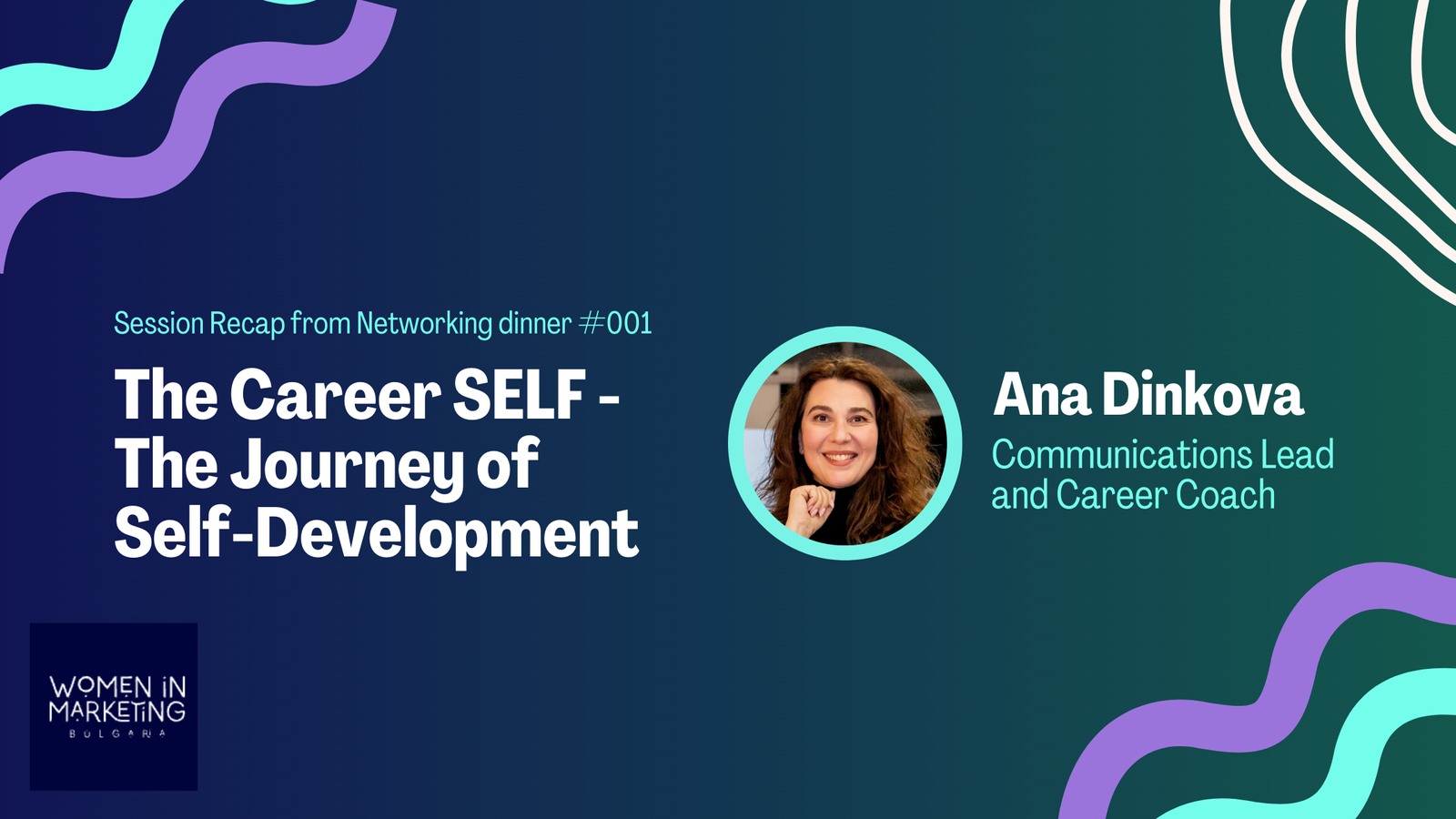
Editor Note: This article, was created by the Women in Marketing – Bulgaria team in collaboration with the speaker Ana Dinkova, and is based on her presentation at our Networking Dinner #001 in Sofia. It’s been edited for conciseness and brevity.
Grab a copy of the extra resources
See what associated resource Ana shared with attendees on the night of the networking dinner and follow along yourself – complete the author’s recommended assessments in your own time. ✨
- Job vs. career (and why the difference matters)
- My early career: fear, public failure, and why I building an alter-ego can help
- Test your story in real life (cheaply, quickly, reversibly)
- Tools that help me define my strengths
- Coach yourself for continuous growth
- Integrate your interests (they’re not “just hobbies”)
- The role of cumulative experience
- Get know the real you
- Belief, intuition, and boundaries
- Presence in practice: breathing, voice, and speaking – without losing clarity
- Discipline VS Inspiration
- Key takeaways (and things to try this month)
- Extra-Curricular: self-coaching toolkit
- Closing: presence over permission
My curiosity about psychology, especially organizational psychology, peaked the moment I realized modern communications isn’t “just comms” anymore. PR isn’t only PR; corporate communications isn’t only corporate communications. We work shoulder-to-shoulder with Learning & Development, HR, Talent Acquisition and Marketing. We’re not just “getting the message out.” We’re asked to move humans – to carry culture through words so people don’t roll their eyes and think, “Oh God, not this again,” but lean in and say, “Okay – there’s something here for me.”
That shift pushed me beyond tactics into the deeper work of knowing myself, building presence, and creating systems that let me show up consistently – especially on the days when self-doubt is loud.
Job vs. career (and why the difference matters)
In today’s fast-paced world, having a job for stability and income is one thing; discovering a meaningful, fulfilling career path is a different game. It’s a journey of planning, navigating complex environments, enhancing skills, and evolving into the best version of yourself. It includes failure – and the resilience to rise again; purpose-seeking; exploring new opportunities; and experimenting.
Ideally, we’d do all that inside psychological safety – trusting that we will not be brought down for speaking up with ideas, questions, concerns, or making mistakes by family and teams. In reality, most of us live under the weight of judgment – mainly self-judgment, plus the expectations of friends and relatives. The pressure to constantly grow can feel overwhelming, especially against rapidly changing workplace dynamics and well-intentioned (but often confusing) advice from the people closest to us.
So where’s the sweet spot – the place where we discover and create our best selves while staying sane, happy, fulfilled, and growing?
One of the most liberating realizations in career development is this: there’s a fine line between what we dream to become, what we plan to work toward, and where our path actually leads. Life will surprise us. We don’t have to control everything around us. The lever we do control is self-knowledge: learning how we react, and building on our predispositions, knowledge, skills sets, and experience. When we leverage those honestly, we align our professional path with who we truly are and who we’re becoming.
At the core of our Career Self sits a balance:
- what comes naturally (inherent talents you can’t help but use), and
- what you choose to practice (skills you stretch on purpose).
A satisfying career uses both: play to strengths and deliberately expand edges. It’s evolution in motion.
A truth I earned the hard way (25+ years in PR & Corporate Communications):
The less you obsess about “success,” the more fun you have – and the more you make people experience the words you speak. That’s when the career journey gets good.
My early career: fear, public failure, and why I building an alter-ego can help
In the beginning of my career journey, my biggest fear was failing in public. It kept me from being present during presentations and from enjoying work I otherwise loved.
It took a while for me to work through my fears, I created simple rituals, used psychology hacks, and lots of basic training that made me feel better and better. Later I discovered an alter ego can help, when I used to blog, Ana Dinkova became Ana Drinkova, a playful wine connoisseur/bon vivant, which made sharing on stage or in writing easier and boosted my confidence – that resonated with a boost in my career. If an alter ego feels too much, fully inhabit your role: ask “What would an excellent Marketing Manager do?”, make a to-do list, and check off each step.
An alter ego can help in your personal life as well. During the pandemic, after bingeing RuPaul’s Drag Race, in a discussion with friends brainstorming our potential drag personas, I came up with Annihilatia Drinkova: she slays, she’s stylish, she’s killing with kindness. The thing is, when I had to face some challenges and losses in my personal life, I evoked Annihilatia knowing she can do anything! It sounds playful; it’s also science. An alter-ego is a bridge state your nervous system accepts so your best behavior can cross.
When I started my career, mentorship sounded “very American,” like life coaching or therapy. Anytime I asked for guidance, I got some version of: “Figure it out. Nobody helped me at 25.” So I did. But later in life I truly embraced the passing on knowledge: learn → test → map the pitfalls → pass it on. This is why I believe that mentorship is great – no matter how old are you, just reach out to a person that has done it – and ask for help, support, or just a simple chat to pick up their brains.
Two corporate stories changed my perspective:
- “Stop asking the room for permission.” A senior director told me I was addressing everyone formally and waiting to be “let in.” “Own your space.” I was all about good manners and subordination, while I needed to make it all about stance. People meet you at the level of confidence you bring into the room.
- “You don’t have the manager’s walk.” I once lost a role to someone with less substance. A colleague said: “He walks in with his head already there. You walk in and then try to convince us.” It stung – and I diagnosed the gap: executive presence signals before you speak. Ditch the self doubt, embrace your knowledge and act accordingly!
Test your story in real life (cheaply, quickly, reversibly)
A family story made this real. When my daughter, 15 at the time said, “I want to be in front of a camera,” an idea she came back with after some filming for a Junior Achievement school project. I asked her to define it: photoshoots? commercials? acting? We booked a professional shoot to test the reality and start from somewhere.
She hated it: a ten-hour day, bright lights in her eyes, no sitting, constant makeup, hair, wardrobe changes. It’s a physically demanding, kind of a contact sport. The win wasn’t getting a gig: it was learning fast and cheap what isn’t her path, what she can do for a living and what is taking a toll on her.
Now I, whenever I have a new wild idea, I ask myself:
- What’s the easiest and fastest way to test it?
- What will it cost to test?
- If I like it, how do I scale it up? If I don’t, how do I exit cleanly?
Tools that help me define my strengths
When I first set career goals, I leaned on academic theory (not great for real life and often impractical) and shared family experience backed up with expectations. Eventually, I realized those weren’t enough, along with learning the practical side of the job, I also needed clearer, data-driven ways to understand myself and figure out not only what I want, but also what I’m good at.
Leverage psychometric tools for self-discovery
Use psychometrics in combination (not as dogma) so you can get a clearer understanding of who you are, like you would assess another person, objectively:
- Big Five / OCEAN — Openness, Conscientiousness, Extraversion, Agreeableness, Neuroticism.
High Openness? You’re likely to thrive in creative, research-oriented, or innovation-driven roles.. - DISC — Dominance, Influence, Steadiness, Conscientiousness.
High Influence? You’re likely energized by communication-heavy roles such as marketing, sales, or public relations. - MBTI / 16 Personalities — preferences across E/I, S/N, T/F, J/P.
Helpful vocabulary for strengths, blind spots, and work styles.
By understanding your profile, you make more informed choices about direction and can target growth where context demands it. Start with credible free versions, then – if you can – bring a career coach to help interpret the results and plan next steps. If coaching isn’t accessible right now, self-coaching works (see below).
You’ll find a “Your Questions Answered + Extra-Curricular Exercises” section at the end with quick primers and DIY steps.
Coach yourself for continuous growth
I love great coaches. I also believe you should know how to coach yourself when budget, time or access are tight.
- Set SMART goals. Specific, Measurable, Achievable, Relevant, Time-bound. Clarity is king.
- Use GROW (Goal, Reality, Options, Will). Name the goal, face current reality, list options, choose and commit.
- Reflect regularly. Ask: What did I learn today? How can I apply it? What are my fears in regard to this?
- Seek constructive feedback – or else – give it yourself. Ask specifics and seek alternatives: “In this situation, what would you do differently?” If none appear, you’re hearing a preference, not a performance note.
- Prioritize with simple tools.
- Eisenhower Matrix: Urgent/Important; Not Urgent/Important; Urgent/Not Important; Not Urgent/Not Important.
- ICE (Impact, Confidence, Ease): score ideas to pick high-leverage moves.
- MoSCoW Method: classify tasks or features into: Must have, Should have, Could have, Won’t have. Helps you separate essentials from nice-to-haves.
- RICE Framework: evaluate initiatives using Reach, Impact, Confidence, Effort. Useful for comparing projects and deciding what to tackle first.
Integrate your interests (they’re not “just hobbies”)
Your interests shape who you are, they also shape how you work.
- Transferable skills: playing music builds discipline, team sports teach collaboration, even baking trains process management skills and patience.
- Find synergies: love writing? That can translate into content creation, communications, or journalism. Are you into tech? Your curiosity could lead toward product, data, or engineering-adjacent roles.
- Network through interests: the communities around your passions often become professional bridges. Meetups, courses, and online forums can spark connections that move your career forward in unexpected ways.
The role of cumulative experience
Your previous roles: the good, the bad, and the downright weird, all compound. Each one leaves behind a trace of experience, insight, and resilience that shapes how you approach new challenges. Even the frustrating or “off-track” jobs contribute valuable lessons: how to adapt, communicate, or manage pressure. Over time, these layers build your unique professional identity, a mix of skills, stories, and instincts that no single role could ever give you on its own.
- Learn from past roles. What energized you? What drained you? Which skills traveled well?
- Build on successes. Document outcomes and context. Use them as proof in interviews and pitches.
- Adapt to challenges. Diagnose what failed and how you’ll approach it differently next time.
Get know the real you
Be careful whom you listen to! As my digital presence grew, so did the unsolicited opinions, especially by friends and family: about my tattoos, my clothes, you name it! Everyone suddenly had advice on how I should represent the leadership role I am in. At first, it was annoying; later, I realized it was simply part of being visible. When you stand out, people project their own expectations – and often insecurities, onto you. So, I made a few simple rules: stay authentic, choose what makes me feel confident, and never let someone else’s comfort dictate my expression.
A few important things when it comes for feedback or mere personal opinions:
- Always ask for specifics: if feedback doesn’t come with a clear example or a concrete alternative, it’s likely a matter of taste, not truth.
- Sort your people: If a tattoo, hairstyle, or blazer color is enough to disqualify me, then those aren’t my people.
- Substance over surface: the people worth your energy will look beyond appearance, they’ll recognize your ideas, your impact, and your integrity. That’s where genuine collaboration thrives.
People’s opinions can influence us, for better or worse. They can motivate us to grow, but they can also throw us off track, planting seeds of doubt and second-guessing. The truth is, everyone has an opinion, but not all opinions deserve your attention. Focus on doing your best, walking your own path, and learning from real experience, yours and that of people who’ve truly done the work. Most importantly, don’t let criticism from the sidelines shape your direction. Never seek advice from those who’ve achieved little or risked nothing; their perspective may be loud, but it’s rarely wise.
Final tip: before breaking the rules, learn them by heart. You can’t challenge convention effectively if you don’t understand it first. Knowing the basics, from etiquette and dress codes to tone, timing, and respect, gives you a foundation to build your own authentic style on top of. Politeness, appropriateness, and good manners never go out of style; they open doors, disarm resistance, and earn trust. Once you’ve mastered the rules, you’ll know exactly which ones you can bend, and how to do it with confidence and grace.
Belief, intuition, and boundaries
Growth isn’t just about building skills,it’s about developing inner steadiness. Belief keeps you moving forward when results are slow, intuition helps you navigate the unknown, and boundaries protect your focus and energy. Together, they form the quiet foundation that sustains confidence and long-term success.
- Celebrate wins (even small ones). Confidence compounds.
- Trust your gut. Intuition is pattern-recognition your mouth can’t articulate yet.
- Embrace failure. It’s the tuition fee for growth, worth it only if you take the lesson with you.
- Choose your circle wisely. Mentors, peers, and friends who bet on your potential accelerate you.
- Set boundaries. Align work with values. Boundaries protect energy, prevent burnout, and keep you useful to yourself and others.
Presence in practice: breathing, voice, and speaking – without losing clarity
I talk fast. I also work hard to make it clear. My husband (a long-time journalist) and old-school trainers left me with three habits:
- Diaphragmatic breathing. Everything starts there.
- Voice placement. Lower and “place” the voice; the warmer timbre naturally slows your pace.
- Pacing radar. If excitement lifts my pitch, I deliberately dial it back.
A simple pre-performance pattern & preparation ritual, that you can perform anywhere:
- Take your stance: feet shoulder-width apart, spine long, shoulders soft, back straight, slight smile.
- Lightly anchor yourself: for me, it helps to do a small tactile exercise: touching my thumb and index finger together and focusing on the sensation for 20–30 seconds.
- Do a breathing exercise: inhale through the nose gently, exhale through the mouth twice as long as the inhale, like slowly letting air out of a valve, think of the word “one: for the duration of the exhale. Repeat 1–3 minutes.
The longer exhale activates the parasympathetic system (the body’s rest-and-digest mode) and brings arousal down. It’s simple, portable and it works.
Discipline VS Inspiration
In the long run, discipline always outperforms inspiration. Inspiration is fleeting, it shows up when it feels like it. Discipline, on the other hand, builds presence through consistency: showing up, practicing, refining. Whether it’s your routine, or the way you plan your day, the way you communicate with others, mastery doesn’t come from a spark of motivation but from repetition done with awareness. Presence isn’t a gift; it’s a habit you train.
My morning system: brain dump → structure → time-block
On heavy days I:
- Bran dump: I make a list of everything for personal and family errands, to work priorities, meetings and even dinners with friends.
- Structure: group by projects, contexts, duration, even location. Then I prioritize – what needs to be done ASAP, what can wait and what I can delegate.
- Time-block: and protect the blocks, use the DND options of all devices and deep dive into the tasks. No distraction, no noise. Only available for family emergencies.
Key takeaways (and things to try this month)
- Career ≠ job. A career isn’t a title, it’s a long, often messy journey toward alignment between your talents and your chosen craft.
- Self-knowledge is your lever. Use tools like psychometrics as inputs, not verdicts; the real proof is in your behavior, how you act, choose, and adjust.
- Presence precedes words. Your energy walks into the room before you say a thing. Learn to own your space.
- Test in the real world. Forget perfect plans. Start small, run quick experiments, and learn from what actually happens.
- Build humane systems. Breathe. Use your voice with intention. Empty your head when it’s full. Block time for what matters.
- Guard your circle. Seek feedback that’s specific and useful. Let matters of taste stay just that. Choose the people who challenge and elevate you.
- Pay it forward. Learn → test → map pitfalls → pass it on.
Do these this month:
- Run DISC + Big Five (or MBTI). Journal what feels true and test it in real life for 30 days.
- Use GROW on one decision you’ve been avoiding.
- Pilot a cheap, reversible experiment on a new interest or idea.
- Try the short-inhale-long-exhale breathing before your next high-stakes moment.
- Do a morning brain dump → structure → time-block on your heaviest day.
Your Questions, Answered, plus Extra-Curricular Exercises
What is the Big Five Personality Test?
The Big Five (OCEAN) assesses five major traits – Openness, Conscientiousness, Extraversion, Agreeableness, Neuroticism – and yields a profile that helps explain differences in behavior, motivation, and fit. It’s widely used in counseling, personal development, and research, and can inform career and education choices. It assesses personality based on five major traits:
- Openness to Experience
- Conscientiousness
- Extraversion
- Agreeableness
- Neuroticism
The test provides a detailed personality profile that helps in understanding individual differences and predicting behavior in various situations. The Big Five is widely used in career counseling, personal development, and scientific research, aiding in making informed career and educational decisions.
Try this: take a reputable Big Five assessment. Write 5 lines on how this shows up at work and 3 experiments to test one insight in the next 2 weeks.
What personality tests help with career self-discovery?
The MBTI Personality Types Test and 16 Personalities (Myers-Briggs Type Indicator) are amongst the most common psychometric tools to classify personality into one of 16 types based on four dichotomies:
- Extraversion (E) / Introversion (I): where you focus your energy: outward or inward.
- Sensing (S) / Intuition (N): how you take in information: concrete facts or patterns and possibilities.
- Thinking (T) / Feeling (F): how you make decisions: logic or values and empathy.
- Judging (J) / Perceiving (P): how you approach life: structure or flexibility.
It helps individuals understand their strengths and weaknesses, preferences, and work styles, and is widely used in career counseling, personal development, team dynamics, and education. Use it as a conversation starter, not a destiny map.
Try this: list 3 situations where your MBTI preferences helped, and 3 where you overused them. Design one behavior to balance each overuse.
How do I better assess my behaviors in a team setting?
DISC maps Dominance (D), Influence (I), Steadiness (S), Conscientiousness (C). It predicts how you communicate, solve problems, and stay motivated. Great for team agreements because it gives shared vocabulary.
The test helps people understand how they interact with others, how they solve problems, and how they stay motivated. DISC is widely used in career counseling, personal development, and improving team dynamics, as it supports communication and understanding among team members.
Try this: ask your team to self-identify their primary DISC letters. Agree on 3 “meeting norms” that respect each style (e.g., agenda in advance for C/S; space for quick ideation for D/I).
How can I manage negative thought patterns at work?
Positive Intelligence (PQ Program) helps identify Saboteurs (your patterns of self-sabotage) and build the Sage (curiosity, empathy, creativity). It uses micro-practices (PQ reps) and reframing to increase your PQ. It’s practical for stress-heavy roles.
Try this: for one week, label a Saboteur in real time (e.g., Pleaser, Hyper-Achiever), do 30–60 seconds of a PQ rep (sensory focus, breath), then write the Sage question: “What’s the smallest, most valuable next step?”
Extra-Curricular: self-coaching toolkit
- SMART goal worksheet: turn one vague wish into a measurable 30-day target.
- GROW prompts: Goal (what exactly?), Reality (what’s true now?), Options (list 5), Will (what will you do by when?).
- Eisenhower / ICE cards: prioritize your weekly backlog.
- Micro-test planner: Hypothesis → Smallest test → Success/Stop criteria → Next action.
- Breathing drill: 2 minutes of inhale (nose) → exhale (mouth) at 1:2 ratio, silently saying “one.”
Closing: presence over permission
From a somewhat shy, self-doubting person, I became the one who walks confidently into a room already in the role, not because I faked it, not because I think I’m better than, but because I built the conditions (clarity, self-awareness, knowledge, presence, boundaries) so my best self could show up on demand. The goal isn’t to be bulletproof; it’s to be prepared.
Luck is what happens when preparation meets opportunity. Gratitude grounds you; discipline carries you forward. Gratitude reminds you how far you’ve come, and discipline keeps you showing up when motivation fades. Together, they build a kind of quiet confidence, the kind that doesn’t shout, but stands tall. And if any of this helps you, pay it forward: to the colleague a step behind, to the team still finding its rhythm, or to your younger self who once needed someone to say, “You belong here. Own your space.”

Ana Dinkova has 23 years of experience in corporate communications and public relations, holding various management positions in reputable companies and organizations. She is currently Communications Lead PR & Media Relations EMEA at Endava, where she develops and implements communication strategies, leads PR initiatives, and manages events. She co-founded digital marketing agency Trinitix, working with corporate clients on communications strategies, reputation management, and crisis communications.

 English (UK)
  Български