
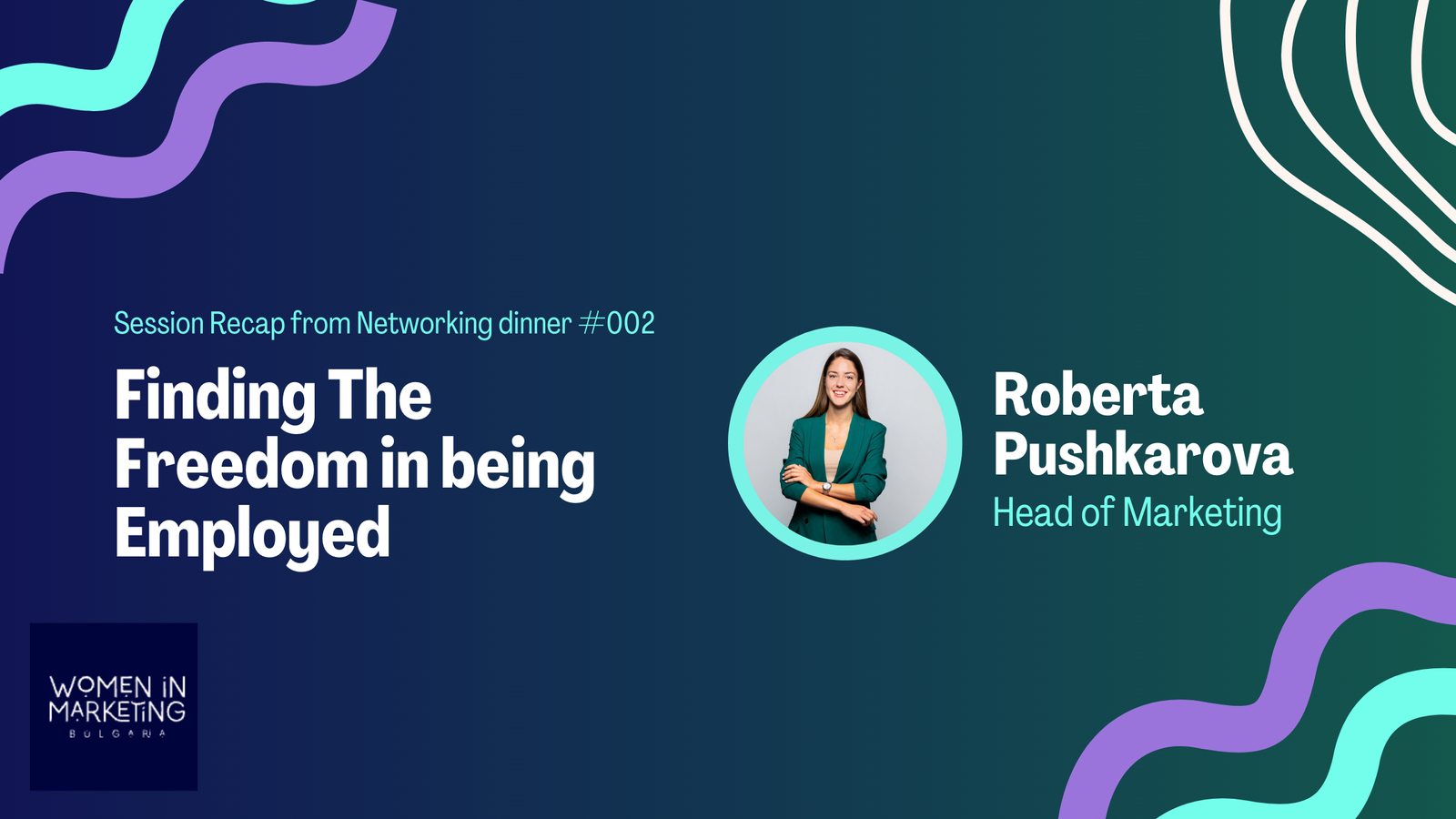
Editor Note: This article, was created by the Women in Marketing – Bulgaria team in collaboration with the speaker Roberta Pushkarova, and is based on her presentation at our Networking Dinner #002 in Plovdiv. It’s been edited for conciseness and brevity.
Grab a copy of the extra resources
See what associated resource Roberta shared with attendees on the night of the networking dinner and follow along yourself – complete the author’s recommended assessments in your own time. ✨
- Where I work (and what that really means)
- The choice that set my trajectory
- What to look for if you crave freedom (inside a company)
- What “marketing at a fund” really looks like
- Role-hopping (the kind that’s hard to do if you’re a founder)
- The underrated pros of being employed
- Managerial muscles I had to grow (and keep growing)
- Don’t live in a bubble (I did—then I popped it)
- Extra tactics that make employment feel like freedom
- Will I ever start something of my own?
- Where I am now (and what’s next)
- What this adds up to (for me)
“Freedom” and “being employed” rarely sit in the same sentence. Yet the last 3½ years showed me that the right company—one with trust, autonomy, and room to experiment—can feel freer than going solo too soon. This is how I learned that, what I actually do inside a venture capital fund, and the specific habits that let me earn that freedom every day.
Where I work (and what that really means)
I’m on the marketing & community side at Eleven Ventures, a VC fund in Southeast Europe. My “customers” form a triangle:
- Founders — intensely smart, ambitious people building and scaling startups.
- Investors — 90+ private investors from Bulgaria and the region who’ve entrusted us with millions to return multiples on.
- Ecosystem partners & community — corporates who can partner or buy from our startups, plus the wider tech community we educate and rally.
We actively support ~70–80 portfolio companies, and we manage the community fabric around them. Case in point: I’m currently running point on a four-day retreat in Greece—agenda, speakers, workshops, logistics—the whole thing. The “army” behind me most days? Me, a new teammate I hired and mentor, and partners who advise at the right altitude.
The choice that set my trajectory
I finished the American University in Bulgaria with a double major (Business + Journalism) and a minor in Marketing—my perfect mix of creative + commercial.
Right out of uni I had two offers:
- Secure full-time job at a large software company—team, processes, great pay & benefits.
- A marketing internship at Eleven—minimal structure, modest pay, no promises for long-term employment.
I listened to my gut and took the internship. I’d done 7–8 months as a PM (websites, ERPs), juggling developers and clients, and between university and COVID I was spent. Eleven became my first real job after graduation. I started as an intern; today I lead marketing, and recently hired my first report.
What to look for if you crave freedom (inside a company)
People to learn from. Partners with decades of scar tissue—some ex-founders with exits—and teammates already punching above their weight.
Ambition + youthfulness. Smart, hungry people who want to build, not just maintain.
A real autonomy contract. On day one I was told our only “policy” is Freedom & Responsibility:
Work where you want and when you want—just own the outcome you committed to.
Permission to experiment. The space to test, ship, and lean into what you do best—not just what a checklist says.
My standing advice: learn what you actually like by experimenting, not by overthinking.
What “marketing at a fund” really looks like
I studied how other funds communicated (spoiler: many didn’t) and started trying… everything: social content, long-form articles, design & visuals, events, media relations, even early SEO and paid experiments.
I found my lane (and my “nope” list)
- I’m not an SEO person. I don’t enjoy it; I’m not great at it.
- I’m not an ads-first person: I prefer organic audience building first; paid is gas on the fire once the funnel is tight.
- I am a storyteller and PR bridge. I help founders translate complex tech into human value, sell a news angle without paying 3,000 BGN for a “sponsored” piece, and land earned coverage—even on mainstream outlets like bTV.
We’re hands-on with portfolio companies
Every new investment gets a 100-day plan we co-create with the founders. I often become their extended marketing team, helping shape:
- brand & messaging foundations,
- content strategy & editorial systems,
- PR narratives & media outreach,
- the first audience loops (community, email, social).
The variety is the gift—you find your edges fast.
Role-hopping (the kind that’s hard to do if you’re a founder)
I didn’t stay in one lane. I embedded with other teams to test my fit and learn the machine.
- Investment Team sprint. I joined our Future of Work vertical with partner Vassil Terziev (now Mayor of Sofia) and a colleague. I wrote investment memos, handled decline emails, and learned evaluation thinking. I also learned I don’t want to be an investor. (My personal nightmare? Excel → Excel → financial model → break-even curves.)
- Operations experiment. I helped design an internal platform to connect the whole community and streamline support.
Both were insanely valuable—and both nudged me back to where I’m best: creative marketing, writing, shaping stories, building audiences from zero without buying attention.
This kind of safe experimentation is a quiet freedom of employment. When you’re a founder or solo, it’s much harder to step sideways.
The underrated pros of being employed
You know the obvious ones (salary, benefits). Here’s what actually matters to me—and how I use it.
Collective energy
I don’t thrive alone at home. On WFH days I’m usually in a café—four walls and silence melt my brain. A team that nudges each other forward is rocket fuel.
Mentorship on tap
Ask for mentors on purpose. My manager and the partners compressed years of growth into months by letting me shadow, debrief, and iterate in public.
Structure without rigidity
Even flexible companies have processes. Seeing “how things work” (cross-team flows, decision paths, quality bars) is a cheat code—whether you plan to climb the ladder, lead bigger projects, or build your own shop later.
The right to switch off
Founders can switch off; it’s just harder. Employment makes it operationally easier to close the laptop. My rituals:
- keep a public priority list so last-minute asks must displace something visible;
- pre-schedule time-brittle posts the night before big events;
- end-of-day shutdown (notes, next-day top-3);
- no Slack on my phone’s home screen during heavy weeks.
Managerial muscles I had to grow (and keep growing)
Feedback: don’t wait—debrief while it’s fresh
After every initiative we run mini post-mortems:
- what worked,
- what didn’t,
- what to tweak,
- what to stop,
- how we each felt, and
- what we’re excited to try next.
A real example: we had a timed announcement during a live event. Chaos hit; the post slipped. Fix for next time: schedule the night before. With my teammate now, we keep these loops short and human, and I added a monthly “pulse” around energy, interests, and desired ownership.
Experiments: run many, kill fast
New formats, mini-campaigns, tiny visual variations—ship, measure, stop if it doesn’t work. The point isn’t to be precious; it’s to learn fast what’s ours.
Time management: the power of “no” (or “not now”)
This took me ages. What finally worked:
- Maintain a public priorities board.
- When a new task appears, share the board: “What should come off so this can go on?”
- Add context: “Current priorities are Founders Weekend and the site refresh; can X wait two weeks?”
You have 24 hours. Protect your life outside work. I still like gold stars—but I like my mental health more.
Delegation: different ≠ wrong
After my manager left, I ran solo for 4–5 months. Full control. Then I hired—and had to relearn that delegation means different, not worse.
Now I hand over full creative freedom (“own it; pitch your ideas”) and resist nitpicking. My perfectionism notices flaws no one else sees. Good enough + on time beats perfect + never shipped.
Don’t live in a bubble (I did—then I popped it)
Early on I was obsessed with the Eleven–startups–investors world. It felt like the only universe. Branching out saved me:
- Mentor the Young (twice as a mentor),
- the ABLE community,
- helping friends kick-start Future Females.
When you widen your circles, you see new paths, new problems worth solving—and your current work gets better. You also build a self that exists beyond your badge, which is healthy and… freeing.
Extra tactics that make employment feel like freedom
- Freedom & Responsibility is not chaos. It’s clear ownership + trust to choose how to deliver.
- Public priorities make trade-offs visible and turn “no” into a collaborative decision.
- Role experiments work best with exit ramps (“one cycle, then review”).
- Post-launch debriefs (10 minutes!) beat quarterly autopsies.
- Pre-schedule the brittle things (timed posts, embargoed news) the night before.
Will I ever start something of my own?
Probably, yes. Ideas are forming. But I still have more to learn and more to give here. My advice if you’re itching to jump at 19 or 20: get some inside experience first. See how things work behind the curtain, discover what you’re good at, what you enjoy, and what belongs on your “nope” list. The leap will feel more natural and the odds will improve.
Where I am now (and what’s next)
Our team grew from ~10 when I joined to ~20 today. I’ve gone from intern to leading marketing, hired my first teammate, and—yes—sometimes I daydream about starting something of my own (maybe one day during maternity; who knows).
But I also know this: I still have more to learn and more to give here.
If you’re itching to leap, here’s my one piece of advice:
Before you take the plunge and absorb all the risk, gain experience.
Learn what you’re good at, what you love, and what the world needs—your ikigai—inside the safety (and growth upside) employment can offer. Experiment across teams. Ask for feedback before it’s due. Build systems that let you switch off. Grow your network beyond your bubble.
Then—when you leap—you won’t just feel “free.”
You’ll be ready.
What this adds up to (for me)
Being employed hasn’t shrunk my world—it’s expanded it. I’ve had:
- mentors I wouldn’t have found solo,
- experiments I couldn’t have afforded on my own,
- structure to learn how things really run,
- and the psychological freedom to close the laptop without guilt.
If you’re in a company right now, use it:
- Chase mentors and ask real questions.
- Cross over into other teams for a sprint.
- Debrief every initiative; don’t wait for annual reviews.
- Experiment widely; quit what isn’t you.
- Say no or “not now” with context.
- Delegate and let “different” be fine.
- Grow your network beyond your bubble.
And if you’re on the fence about the “freedom” part—remember: trust + autonomy + room to experiment is a kind of freedom too. Sometimes, it’s the freest place to grow.

Roberta Pushkarova
Roberta Tihomirova is a Marketing Manager at the venture capital fund Eleven Ventures, an ambassador for the organization supporting women entrepreneurs, Future Females Sofia, and a co-founder of the accelerator program DEA Accelerate.

 English (UK)
  Български